Saturday, September 11

Henry Miller: a good companion when one is having a Season in Hell

I have to stop using the computer for some days because of back problems so I will share with you what I'm rereading by Henry Miller. No, not one of the "Tropics". It is a 163 pages book he wrote about Rimbaud: "Henry Miller's The Time of the Assassins : A Study of Rimbaud (1949 New Directions Publishing, 163 pp). It is not a critical essay and it has more to due with an autobiography and his moral and intellectual legacy. He makes some approximations between artists and dedicates a long part comparing Rimbaud and Van Gogh's lives taking into consideration not the craziness but a circumstance that few biographies remember, especially about Van Gogh ,: the poverty both lived and the impact it had on their way of being in the world.
I'm having a good time rereading it and finding some thoughts that although written sixty-one years ago reflect the same problems of today.
I hope I can update the blog. If not I will try to publish some excerpts I like:
"Rimbaud restored literature to life, I have endeavored to restore life to literature. In both of us the confessional quality is strong, the moral and spiritual preoccupation uppermost." "I think there are many Rimbauds in this world and that their number will increase with time. I think the Rimbaud type will displace, in the world to come, the Hamlet type and the Faustian type. The trend is toward a deeper split. Until the Until the old world dies out utterly, the "abnormal" individual will tend more and more to become the norm. The new man will find himself only when thewarfare between the collectivity and the individual ceases. Then we shall see the human type in its fullness and splendor." To get the full import of Rimbaud's Season in Hell, which lasted eighteen years, one has to read..." Henry Miller
And this is Rimbaud:
"I invented the colors of the vowels!- A black, I red, O blue, U green- I made rules for the form and movement of each consonant, and, and with instinctive rhythms, I flattered myself that I created a poetic language accessible, some day, to all the senses." -Une Saison en Enfer, "Délires II: Alchimie du Verbe"
A black, I red, O blue, U green Image: Preface of the book picture taken By Joe Camel published at Flickr

CIA and Wikipedia inspiring Art: The Color of all Flags of the World

Flags of the World">
In his
Flags By Color project, Shahee Ilyas uses a list of countries generated by The World Factbook along with the world's national flag images fetched from Wikipedia to produce a series of charts that break down the color proportions for each flag. These proportions of color are then displayed in a single chart revealing the color proportions of all of the flags of the world combined. This project was generated entirely with script.
(Piechart of proportions of colours for all the flags combined.)

At the top right the little image is a link to CIA's The World Factbook. I think it is amazing to have the colors of all the flags of the world united. It should be used as an icon for uniting. It seems that globalization has more to do with disuniting. Art is always what unites people. (click at the images to go to the project and watch the flags) You can also look at this post to easily know the flag of each country. Have a great weekend!

Friday, September 10

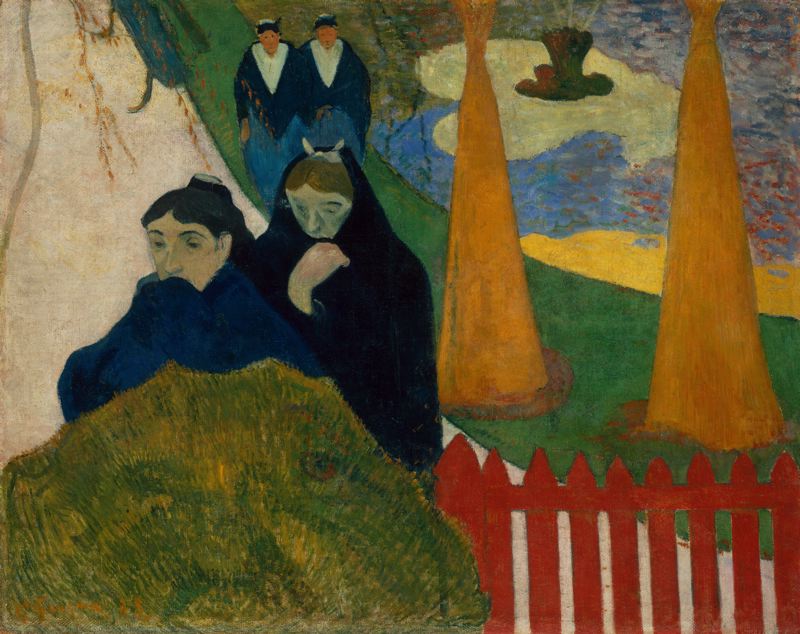
Van Gogh and Paul Gauguin working together in Arles

Left: The Dance Hall in Arles, 1888, Van Gogh
Right: The Arlesiénnes, 1888, Paul Gauguin
These are the paintings that Gauguin and Van Gogh did together during Gauguin visit at Arles.
It is amazing how Van Gogh did this work in a very different style as if it was a stained glass:
"This painting seems to show an evening at the Folies-Arlésiennes, a dance hall on Boulevard des Lices. Gauguin's influence is clear as Van Gogh scrupulously applies the principles of synthesism and cloisonnism developed by his friend at Pont-Aven. The reference to Japanese art is also evident, with the unusual elevation of the horizon, and in the strange, decorative foreground where the curves and counter curves of the hair are dominant.
The multitude of characters, the variety of their style of clothes and the way they overlap, skilfully portray a feeling of crowdedness and saturation. The portrait of Madame Roulin on the right, who alone turns to look at the spectator, seems to express a claustrophobic terror. In Gauguin's Arlésiennes, two female characters also express anxiety and anguish.
To escape this latent anxiety, the two men went to Montpellier on 16th or 17th December to visit the Musée Fabre. The arguments that followed highlighted their aesthetic disagreements more than ever. As a result of this day out, their separation became inevitable, and Gauguin prepared to leave."
No matter what is said when I look at Van Gogh painting I like it and can even find some peace. I would love to see the original.
Test from the Musée D'Orsay site.

Thursday, September 9

Very Demotivational post

demotivational posters - SUBMARINE RACING
I loved it! Hope you are in the same mood. I can't hardly wait to see who will win and of course I watch till the end!

Tuesday, September 7

Sunday, September 5

Suzanne Valadon model and artist helps seeing the difference among impressionists

Suzanne Valadon started modeling for impressionists at a very young age following her mother's steps but she did fight not to be stigmatized and treated like a whore like her mother. She became herself a painter and her son Maurice Utrillo is a known artist. She modeled for Degas, Renoir, Puvis de Chavannes, Toulouse-Lautrec and others. I didn't know it was her at this work by Toulouse Lautrec, The hangover, 1888 and another Lautrec's work I like, The Laundress, and published here. By looking at the way the impressionists portrayed her what is striking is that it is possible to see the different approach of impressionists. Too much is said about what impressionists have in common and few about every artist uniqueness. I will just publish the Lautrec today because I really like this work and leave the others for another post.

Saturday, September 4

Pablo Picasso the blue period and portrait of Gertrude Stein

Right: The Blind Man's Meal, 1903, by Pablo Picasso Left: Gertrude Stein, 1905–6, by Pablo Picasso The Blind Man's Meal is part of the blue period, 1901 until 1904, a phase where Picasso's work shows loneness, abandonment, desolation and sorrow in a very deep way using all hues of blue. After settling in Paris in 1904 he started changing his colors and motifs. Gertrude Stein, the American poet, used to gather people on Saturdays at her home and many of the intellectuals used to attend to discuss and have fun. This is the story of the portrait of Gertrude Stein:
In her book The Autobiography of Alice B. Toklas (1932), Stein described the making of this picture: "Picasso had never had anybody pose for him since he was sixteen years old. He was then twenty-four and Gertrude had never thought of having her portrait painted, and they do not know either of them how it came about. Anyway, it did, and she posed for this portrait ninety times. There was a large broken armchair where Gertrude Stein posed. There was a couch where everybody sat and slept. There was a little kitchen chair where Picasso sat to paint. There was a large easel and there were many canvases. She took her pose, Picasso sat very tight in his chair and very close to his canvas and on a very small palette, which was of a brown gray color, mixed some more brown gray and the painting began. All of a sudden one day Picasso painted out the whole head. I can't see you anymore when I look, he said irritably, and so the picture was left like that."
Source: Metmuseum

Friday, September 3

Rowan Atkinson Live - The devil Toby welcomes you to hell

I am feeling better. This is too funny! I really needed that.

Three Flags by Jasper Johns

I think that if you live in America you might have already seen a reproduction of the "Three Flags", 1958, by Jasper Johns or any of his other works with the American flag. If you did see it you now it is time for the question: "what does it means?"; "what does he want to say with this?" and surely other things are coming to your mind. Sad news: I have a fever today and my body is aching all over. Please, search at Google. You can start at this site here. Wish me luck. It is aching... reasoning disappears and we only want to get better. Leave me a comment telling what did you find about Jasper Johns. :) You can teach how to fish or... I don't remember the saying.. bed.. bed..

Wednesday, September 1

Paco de Lucia, Johnny Depp, Marlon Brandon Faye Dunaway and Bryan Adams welcome September

September, for those who are below the Equator, is the prelude of warm times. I did chose Paco de Lucia to welcome the month and we can all stay warm in heart that is the important place. Entre dos Aguas is one of his most famous musics and I remember the first time I heard it back in the end of the 70ies I wanted to listen to it one more time, one more... and it is still so. We can all stay warm dancing or watching flamenco dancers:
"Also Flamenco dance has changed, specially female dancers try to rather showcase their temperament than artistry. The Flamenco guitar that formerly was just featuring the dancers arrived to be a soloistical art form, great virtuoso Paco de Lucia being the pioneer of that development. Mass medias have brought Flamenco to the world stage, but deeply it has always been and will remain an intimate kind of music. You have not listened authentical Flamenco if not in a juerga with a small group of friends, at midnight somewhere in the South of Spain, when there is nothing around but the voice, the guitar and the body of a dancer moving in the moonlight."
In the meantime take a look at these photos of dancers. Paco de Lucia has recorded and participated in films such as Carmen by Carlos Saura and in 1995 was featured in Bryan Adams hit "Have you ever loved a woman" for the movie Don Juan deMarco. I watched the movie and I have good recollections and Marlon Brandon is still on my mind. "So tell me have you ever really - really really ever loved a woman?" Have a great September! Music unites people. Update: September, 3 You can click at the video "Rio Ancho" when the first video finishes. It is as amazing and also very known music. I wonder how some people can go through life without knowing some of the incredible things some people created. Paco de Lucia is at this list for me.

Tuesday, August 31

Xenophobia

That was the word Vanessa Redgrave did answer James Lipton for the question "What is your least favorite word?" on the famous "Inside Actor's Studio". I admire this woman immensely. Julia is one of my favorites movies and she told how she came up producing and acting. She was on a theater and a cinema usher showed Lillian Hellman's book and as she didn't had read he lend it to her. She did read it in one night and decided to make the movie.
Xenophobia comes from the Greek words ξένος (xenos), meaning "someone with whom you are not acquainted", and φόβος (phobos), meaning "fear". In the beginning of this century while the word globalization conveys a sympathetic image but covers the worst face of the capitalistic system, whose sole aim seems to be producing money and it's values are spreading all over the world, xenophobia is being manifested in many different ways. I would think twice spending one year in Paris while on the eighties I was received with great hospitality. Perhaps because I was around people linked to arts but I'm not sure. I was treated well by French people everywhere I went. I speak the language and it helps. But I'm not sure if it would be the same. I've received a six month visa in UK although I was just spending a week before returning home. But from the news I've been reading and talking to some English and French people it seems that things would be very different.
I hope that I am wrong but I witness strange things happening in social networkings and virtual worlds. Still nothing is being discussed.
Adapted from a post I did at justAna .

Sunday, August 29

Dante Gabriel Rosseti illustrations of poetry


Rossetti illustrated poems and this is the frontispiece of her sister's book "Goblin Market and Other Poems" published in 1862. He also did projects for stained glasses but as soon as you look at one of his works as an illustrator, painter or in his drawings for the stained glasses the firts thing that comes to your mind is "Oh! A Rossetti." He was also a poet.

Saturday, August 28

Going to California: Trying to find a woman who's never, never, never been born

As the month is ending and I confessed being a fan :), I want to share this music and I will not publish Led Zeppelin any longer. This music is inspired by Joni Mitchell's "California", you can listen to this song too, as Robert and Jimmy were fans of her. A very beautiful collection of images was done by francescadonna for this very sweet, thou sad, song: "Spend my days with a woman unkind Smoked my stuff and drank all my wine Made up my mind, make a new start Goin' to California with an achin' in my heart Someone told me there's a girl out there With love in her eyes and flowers in her hair Took my chances on a big jet-plane Never let 'em tell ya that they're aw-ooh-all the same Hoh, the sea was red and the sky was grey I wonder how tomorrow could ever follow today-hee Mountains and the canyons start to tremble and shake The children of the sun begin to awake Now Watch out It seems that the wrath of the gods got a punch on the nose And it's startin' to flow, I think I might be sinkin' Throw me a line, if I reach it in time Meet you up there where the path runs straight and high" Find a queen without a king They say she plays guitar and cries and sings, la-la-la-la Ride a white mare in the footsteps of dawn Tryin' to find a woman who's never, never, never been born Standin' on a hill in the mountain of dreams Tellin' myself it's not as hard, hard, hard as it seems."

Friday, August 27

A hug to my blog friends

It's been a long time I'm wanting to do it. I am not a good blog-friend because I don't visit people I admire and care about as much as I should. This is very strange that although we only know one another by blogs we have a kind of connection that is like a friendship and sometimes while doing any daily activity we remember a blog friend, promise next time online we will visit but we don't. I even tell people about some of you and it seems as if I'm talking about someone I saw yesterday. All I want to say is that although I don't visit blogs that often you are always next to me and are part of my emotional life. You are all very important to me. So this is a ((((((((((((((((HUG)))))))))))))))))) to all of you. Image by Alexis L.

Thursday, August 26

Tim Curtis's animated photographies: waterfall with rainbow

Copyright All rights reserved by _Tim Curtis_ I just found Tim Curtis at Flickr and I'm amazed. There is another photo he did at the Fall Creek Falls State Park in Tennessee of this moment here and you can see the reflexion of the rainbow. Great timing! The animation is an extra and you can take a tour at his site where he did some incredible animations that look like videos.

Wednesday, August 25

Dolphins in Crete: Now and Then

The ruins of Knossos palace, ancient Greece, were discovered in 1878 and among other frescoes there are these dolphins. The video was done in 2007.

Tuesday, August 24

Monday, August 23

James Joyce in the news; William Blake and... Hemingway?

"Deal with him Hemingway, deal with him." lol
The only reason that makes me doubt that something like that could appear on the news today is that writers are not celebrities and their lives are not a good source of gossip. I found it funny and I also want to take Joyce away from this difficult and unattainable place he is .
Yes, he has a difficult and different way of writing but shouldn't be left only for scholars and few people who like it.
There are many books published about "how to read Ulysses" and I found this site here that is very simple, is very easy to understand and helps those who are not familiar with Joyce's universe.
As far as the scholars are concerned I found this study Elaine Mingus did about James Joyce and William Blake. What I liked about it is that she raises the complexity of both writers without closing the door using theories and insights that makes it more difficult to read their work:
JAMES JOYCE AND PALE BLAKE
By Elaine Mingus
Critics and scholars often do not agree on the writings of either Joyce or William Blake. This is because of their complexity, also inconsistencies especially in Blake, and it humbles us to try and understand their writings. Nor is there agreement about how and how much Joyce used the writings of Blake. I have tried to steer a middle course between two extremes. There are sources common to both, such as The Egyptian Book of the Dead. Some things were merely corroborated for Joyce in Blake. Whatever Joyce did take from anyone was reshaped, expanded, and fused into his own vision.
William Blake was an engraver by trade and had his own technique of illuminated printing. He embellished all of his writing beautifully in color and also with drawing, and was better known for his painting than for his writing.
Blake lived in London from 1757 to 1823, a very different time than Joyce’s time. It was an age that was very unsympathetic to any “open vision” or what seemed eccentric or heretical. But Blake was from a dissenting family with the belief that God might speak to one directly. He was self-taught and did not accept anything wholly but was inspired by Jacob Boehme, Swedenborg and others. He greatly benefited by his marriage to Catherine Boucher and she supported his efforts always.
“Imagination leads to wisdom and insight” said Blake, and “The harlot’s cry from street to street shall weave Old England’s winding sheet”. He had his own style and copied no one.
Blake believed in the divinity of man and in identification of body with soul. He was not seen as a mystic but a visionary artist and poet. He was once considered a madman, now revered as a major poet of English Literature, though still considered by many to be a genius who was half-mad. Blake once said, “The prophets Isaiah and Ezekial dined with me”, and he claimed that supernatural powers dictated to him. In his “Milton”, Milton reincarnates and enters the body of Blake.
William Blake was greatly influenced by the American and the French Revolutions which he and others thought heralded the Apocalypse, expected at any time. A social rebel with very radical beliefs, Blake was mainly ignored by the general public. He rebelled against prevailing Victorian morals. “Thou Shalt Nots”, and followed natural instincts rather than adhere to standards of society, and the same can be said of Joyce. Blake was a symbolist who invented his own symbols, like spectres and emanations.
“I must create a system or be enslaved by another man’s”, he said.
The British government was cracking down on radicals, and some of Blake’s friends were being jailed, which is partially the reason for some of the obscurity in his writing. As with Joyce, he had financial difficulties all his life in part because of the lack of getting published. (Keep reading)
Ulysses is one of the most important works of the last century and I will publish more about it.