
Showing posts with label Van Gogh. Show all posts
Showing posts with label Van Gogh. Show all posts
Monday, August 24
Akira Kurosawa-Dreams-Vincent Van Gogh
I felt like sharing it. I'm having to work this year and there is no time left to update the blog.
I miss it...


Wednesday, February 5
Van Gogh's realistic studies of hands


These are studies Van Gogh did in 1885.
For those who think that impressionists cannot draw here is the answer.
They did it not as an end in itself but as an exercise to achieve what they wanted to paint. There are other studies and I'll publish them this week.
Thursday, November 29
Sorrow by Van Gogh

I still have no computer and I'm also in a difficult period. People hurt sometimes. We have to mourn and regain strenght.
I miss blogging and my virtual friends. You're all with me and it is good to know that you're all there even thou we never met. It's amazing how deeply connected I feel to many people. It's good
People we get in touch are part of our universe and affect us. It is a blessing to have people around the world that I can feel that are close to me.
I want to make a post about this kind of bond we have in the virtual world. Not now. I'm very sad.
I never did a post like this and... dunno. I have to regain control over my emotions. Yes... I'm crying.
Love and peace to all of us.
Image: Sorrow, 1882, by Van Gogh
Tuesday, December 27
Van Gogh's Bedroom: Painting's reproductions in danger


These details of Van Gogh's bedroom, and the Bible of his "L'Arlesienne, this post, are great examples of the way reproductions by internet could give a more accurate notion of how a painting is seen in reality.
Unfortunately these are rare even thou now people go to museums with cameras but they prefer taking a picture of themselves next to their favorite or most famous paintings they find.
When only paper was available and a single picture of a painting was published in different books there was always a great disappointment in front of the real canvas. I felt fulled.
When I saw this version of Van Gogh's bedroom for the first time I questioned everything I knew about all the artists I had never saw at least five original works.
I could never imagine that the brushstrokes were that sick and he used impasto.
I could not take my eyes from the pillows and, sorry conservation team, I touched the left pillow because I simply could not restrain this impulse.
What I'm witnessing now is a degradation of images of paintings.
There are several sites selling famous masterpieces by repainting them and they are found at search engineers as the first answers if one looks for an artist.
People are publishing these paintings as originals over blogs because they rush to publish the first picture without reading they are fake and has little to do with the original. Usually the colors are different or brighten to make it more appealing giving that plastic flower effect on the table instead of the real one.
It is getting harder and harder to find a good reproduction over the www.
Most museums, I thought they would promote their masterpieces through the web, are not helping publishing good images and are more interested in using interactive experiences that only change angles in a suspicious 3D environments, or other kind of interaction.
In same cases, they don't publish 10% of what they have and are always inviting us to go to their next exhibition even though we are at the other side of the ocean.
For the moment I'll watch these two Bedroom's details: look that, as he said in a letter to Theo, he uses green at the pillows and a little bit of white.
Thursday, November 17
The Good Samaritan by Delacroix and Van Gogh


Right: The Good Samaritan, 1890, by Van Gogh
Left: The Good Samaritan, 1849, by Eugène Delacroix
I have already published some of the Van Gogh paintings that were inspired by other artists and this is
another of these great achievements Vincent left. He also painted after Delacroix here.
It is a great way to see the impressionist changes in the way artists depict space, light and realize that they have other intentions than their predecessors.
The paintings are only forty one years apart. Some might think that Delacroix is more realistic
or more faithful or more anything but art's function is not portraying reality the closest possible and if
it was for that some restrictions would also be necessary to Delacroix.
This is a discussion that has been around since the ancient Greeks and it will be in one post.
Keep tuned. :)
Friday, November 11
Van Gogh's Breton Women after Émile Bernard


Right: Breton Women in a Meadow, 1888, by Emile Bernard
Left: Breton Women in the Plain of Pont-Aven _after Émile Bernard_, 1888, Van Gogh
He also painted two or more versions of his own work as pointed out at these two paintings of Père Tanguy portrait.
I just found Breton women he did after Émile Bonard and felt like sharing.
There are lots of Van Gogh paintings at the WEB that I have never seen and this is one of the bright sides of the internet.
Thursday, July 14
David Hockney, Homage to Van Gogh and wisps


Left: Homage to Van Gogh, 1988.
Right: Moving wisps. 1995.
It is a party of colors. The right is at a private collection and I feel very sad that such a great painting, that makes our eyes move to one texture to another, is not available to the public.
In the left Hockney homages Van Gogh by recreating the artist famous chair "Chair and Pipe" done in 1888 a century ago. I will do a post about how this chair became part of Van Gogh's iconography.
I created a label for David Hockney because he has been coming here many times.
Saturday, July 9
Van Gogh's La Pietà after Eugene Delacroix

 Right: La Pietà by Eugene Delacroix, 1850.
Left: Van Gogh's La Pietà after Delacroix, 1889.
While Van Gogh was at the hospital in Saint-Rémy he kept painting and he had a lithograph of Delacroix's painting that he used as model.
Van Gogh seldom used biblical themes thou he wanted to be a pastor during his youth following his father.
“I am not indifferent, and pious thoughts often console me in my suffering.” he wrote to Theo, his brother.
This is how he describes Delacroix's Pietà:
"The Delacroix is a "Pietà" that is to say the dead Christ with the Mater Dolorosa. The exhausted corpse lies on the ground in the entrance of a cave, the hands held before it on the left side, and the woman is behind it. It is in the evening after a thunderstorm, and that forlorn figure in blue clothes - the loose clothes are agitated by the wind - is sharply outlined against a sky in which violet clouds with golden edges are floating. She too stretches out her empty arms before her in a large gesture of despair, and one sees the good sturdy hands of a working woman. The shape of the figure with its streaming clothes is nearly as broad as it is high. And the face of the dead man is in the shadow - but the pale head of the woman stands out clearly against a cloud - a contrast which causes those two heads to seem like one somber-hued flower and one pale flower, arranged in such a way as mutually to intensify the effect."
Looking at the two paintings side by side is amazing.
Saturday, May 21
Van Gogh's Dr. Gachet painting hide ans seek story; art as commodity


The right painting is missing.
Van Gogh had given it to Dr. Gachet* and the painting is having a very difficult existence.
Sold for the first time in 1897 for £300 it was confiscated in 1930 by the Nazis as degenerated art, found in 1937 to be sold in 1938 by a greedy Goering**, known as an art thieve, for $53 000 and last seen in an auction in 1990 being sold for $82,500,000 to Ryoei Saito a Japanese art lover that wanted the painting to be cremated with him. He died in 1996 and the painting was not cremated but it disappeared.
This price Saito payed made the painting be the number four at the top ten most expensive masterpieces what is ironic when we remember that Van Gogh didn't sell any painting during his lifetime and lived asking money to his brother.
Now, thanks to a crazy art dealer the painting is missing. Many questions arise from this occurrence being one of them: have art became a commodity? to whom masterpieces belong?
The left painting is the copy Vincent has made to himself and is now at the Musée d'Orsay, Paris France.
In a letter to his brother Van Gogh wrote about Dr Gachet's painting:
"I've done the portrait of M. Gachet with a melancholy expression, which might well seem like a grimace to those who see it... Sad but gentle, yet clear and intelligent, that is how many portraits ought to be done... There are modern heads that may be looked at for a long time, and that may perhaps be looked back on with longing a hundred years later."
"What impassions me most- much, much more than all the rest of my métier – is the portrait, the modern portrait. I seek it in color, and surely I am not the only one to seek it in this direction. I should like – mind you, far be it from me to say that I shall be able to do it, although this is what I am aiming at – I should like to paint portraits which would appear after a century to the people living then as apparitions. By which I mean that I do not endeavor to achieve this by photographic resemblance, but by means of our compassioned expressions – that is to say, using our knowledge of and our modern taste for color as a means of arriving at the expression and the intensification of the character."
"So the portrait of Dr. Gachet shows you a face the color an overheated brick, and scorched by the sun, with reddish hair and a white cap, surrounded by a rustic scenery with a background of blue hills; his clothes are ultramarine – this brings out the face and makes it paler, notwithstanding the fact that it is brick-colored. His hands, the hands of an obstetrician, are paler than the face. Before him, lying on a red garden table, are yellow novels and a foxglove flower of a somber purple hue. My self-portrait is done in nearly the same way; the blue is the blue color of the sky in the later afternoon, and the clothes are a bright lilac.” Letter written in 5 June 1890.
*Dr. Gachet is the doctor who took care of Van Gogh during his stay at the doctor's home in Auvers-sur-Oise.
** Goering was the Commander-in-Chief of the German Air Force sentenced to death at Nuremberg trial. He committed suicide before the sentence was executed.
Saturday, April 16
The Night Cafe by Van Gogh in a 3D virtual World


This is the painting at the post below that was reproduced at Second life by Mudpuddle Cleaslate.
He did seven reproductions of Van Gogh's painting at his "Van Gogh's Arles" venue. As you know Arles is the city Vincent lived in France and he did many paintings depicting places and people of the city being the most famous "The Bedroom", that I visited in September 2009, this post, but could not fully understand and enjoy.
I love going to this place and see my avatar walking at "Arles" and entering the paintings. I took some pictures that I want to share but I spent more than one hour at Voicethread editing but they don't offer the embedding code.I will try to edit a slide-show.
Click at the pictures to enlarge.
Monday, April 4
Peasant family at the table: The potato eaters by Van Gogh


"I have tried to emphasize that those people, eating their potatoes in the lamp-light have dug the earth with those very hands they put in the dish, and so it speaks of manual labor, and how they have honestly earned their food."
Vincent Van Gogh
Peasant family at the table was a theme explored at that time but the right painting, 1882, by Josef Israels is known to have influenced "The Potato Eaters".
Funny because they only have in common the number of relatives at the table and the light. Van Gogh said in one of his letters that the frame should be yellow so that it was possible to see all the colors which shows that even prior to be influenced by the impressionist colors he already had a different view about the light and colors. I'm searching for the paintings that are not very known. If you know of any site please tell me. Unfortunately cannot travel now or I would go to every city that has a not famous Vincent, especially private collections. I don't know what is the town that if a person has a painting of a famous artist he/she has to leave people visit it. I'll search for that because I'm not making it up. Seriously!
Van Gogh by himself: Painted with words

I did some post about Van Gogh and this one expresses my concerns about how his biography led to many misunderstanding about his work. Finally I find people with the same concerns and freeing Vincent from this mistake that caused a lot of harm for the fully comprehension of his work. As I said his letters are the source for understanding his deep views on art and the joy painting was for him.
This BBC video "Painted with words", presented by Alan Yentob, with Benedict Cumberbatch in the role as Van Gogh is a great way to understand Vincent because it's done with excerpts of his letter but I still think that they focus on biography instead of the many remarks he did about his painting, the books he read, other artist's work and other issues we can find at the letters.
The paintings they show are those we know and Van Gogh left 800 paintings that are spread all over he world. Still it's worth watching and don't postpone because I believe that BBC will soon take it out from Youtube. This is the first part and you can see the other five clicking "part 2, 3, 4, 5 , 6) from here being the number 3 and beginning of 4 the one that has more to do with Vincent's art free from his biography. What is striking is that at number 4 he is diagnosed bipolar disorder which is an absurd since this diagnose is being done today more than a century after Vincent's life.
But one question about his biography I would like to have clarified: how can it be that he didn't sell anything during his life if his brother worked in Paris for an art gallery and was the responsible for selling Vincent's works? Irony?
Benedict Cumberbatch did a great work! Standing ovation!
Left: Van Gogh 13 years-old
Friday, September 10
Van Gogh and Paul Gauguin working together in Arles

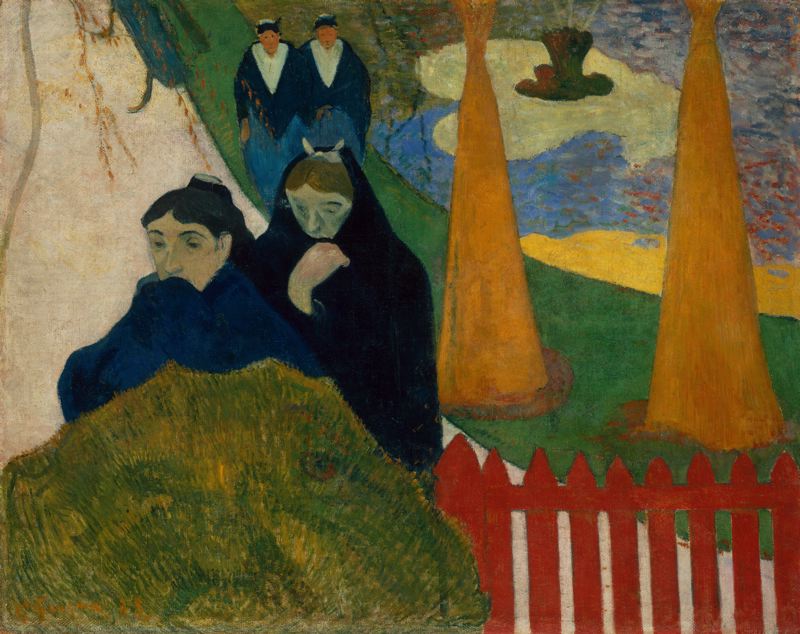
Left: The Dance Hall in Arles, 1888, Van Gogh
Right: The Arlesiénnes, 1888, Paul Gauguin
These are the paintings that Gauguin and Van Gogh did together during Gauguin visit at Arles.
It is amazing how Van Gogh did this work in a very different style as if it was a stained glass:
"This painting seems to show an evening at the Folies-Arlésiennes, a dance hall on Boulevard des Lices. Gauguin's influence is clear as Van Gogh scrupulously applies the principles of synthesism and cloisonnism developed by his friend at Pont-Aven. The reference to Japanese art is also evident, with the unusual elevation of the horizon, and in the strange, decorative foreground where the curves and counter curves of the hair are dominant.
The multitude of characters, the variety of their style of clothes and the way they overlap, skilfully portray a feeling of crowdedness and saturation. The portrait of Madame Roulin on the right, who alone turns to look at the spectator, seems to express a claustrophobic terror. In Gauguin's Arlésiennes, two female characters also express anxiety and anguish.To escape this latent anxiety, the two men went to Montpellier on 16th or 17th December to visit the Musée Fabre. The arguments that followed highlighted their aesthetic disagreements more than ever. As a result of this day out, their separation became inevitable, and Gauguin prepared to leave."
No matter what is said when I look at Van Gogh painting I like it and can even find some peace. I would love to see the original.
Test from the Musée D'Orsay site.
Sunday, July 25
Van Gogh and Hokusai's tree on blue background


Whenever I look at this van Gogh's painting, Almond Blossom, I think about Hokusai's work.
I don't know if van Gogh saw this printing but it's known that he was influenced by Japanese's art like many of his contemporaries and bought some of them.
Or it's quite a coincidence!
Monday, December 14
Van Gogh's letters to Theo available online till January 3
I never met anyone who claimed "I don't like Van Gogh". He is one of the most known and admired painters and part of this posthumous celebrity, I bet you know he didn't sell a single painting during his lifetime, is due to the fact that his biography, specially his poverty and craziness, is common knowledge.
Whenever someone wants to illustrate with art something related to sadness, depression, emotional struggle the likelihood to choose Van Gogh is very high because after all he is the one who "..,knows the darkness of my soul." as the song says.
Until today his disease is diagnosed and he has been labeled all mental diseases. Scholars, psychologists and psychiatrists read his 902 letters searching for a demonstration of a symptom and a mere headache and the expression of normal sadness, or complains of a noisy street is highlighted as a symptom of schizophrenia, depression, epilepsy, agoraphobia, or whatever diagnosis is being proposed.
I think it's already too hard to be in front of a patient and find the right diagnosis and make a collection of letters pieces of a puzzle to a diagnostic guess is something beyond my comprehension.
The sad consequence is that his work is seen as an expression of his madness. The perspective of the bedroom is not correct or the window is closed? It might be because he was hallucinating and because he feared the outside world. I have a book by a French psychologist that claims that a certain white flower in the wallpaper means loneliness among many other strange findings.
Wallpapers like that are very common in French painting of that period and many aspects that belong to aesthetics or iconography field is not taken into consideration.
When I did read "Letters to Theo" for the first time the opposite happened to me. I was amazed by all the happiness and passion he has for his work, the admiration he has for some painters and writers, his culture, and the joy he claims painting is for him: "Painting is such a joy for me."
I realized that I should look at these paintings forgetting all I knew about his biography and for the first time I was able to really see his work and the joy he expressed in every brush stroke.
I am not claiming his health was perfect but seeing his oeuvre only in the lights of a disease is not productive and covers many of the uniqueness of Vincent's work. Even when he portrays himself with the ear cut there is an easel and a painting hanging on the wall at the background and he does not look desperate.
There are other painters and writers who were not that healthy and nobody even knows about it.
I found this site where there is the English version of the letters and I hope you enjoy it the same way I did. It's from the Van Gogh Museum in Amsterdam that I visited some years ago and didn't want to leave.
This is the link.
[Letterhead: Goupil Paris]
Paris, 15 July 1875
My dear Theo,
Uncle Vincent was here again, we were together quite a lot and talked about one thing and another. I asked him whether he thought there would be an opportunity to get you here, into the Paris branch. At first he wouldn’t hear of it, and said it was much better that you stay in The Hague; but I kept insisting, and you can be sure that he’ll bear it in mind.
When he comes to The Hague he’ll probably talk to you; stay calm and let him have his say; it won’t do you any harm, and later on you’ll probably need him now and again. You shouldn’t talk about me if it’s not the right moment.
He’s terribly clever, when I was here last winter1 one of the things he said to me was ‘perhaps I know nothing of supernatural things, but of natural things I know everything’. I’m not sure whether those were his exact words, but that was the gist of it. 1r:2
Sainte-Beuve said, ‘There is in most men a poet who died young, whom the man survived’3 and Musset, ‘know that in us there is often a sleeping poet, ever young and alive’.4 I believe that the former is true of Uncle Vincent. So you know who it is you’re dealing with, and so be warned.
Don’t hesitate to ask him openly to have you sent here or to London.
I thank you for your letter of this morning, and for the verse by Rückert. Do you have his poems? I’d like to know more of them. When there’s an opportunity I’ll send you a French Bible and L’imitation de Jesus Christ.5 This was probably the favourite book of that woman whom P. de Champaigne painted;6 in the Louvre there’s a portrait, also by P. de C., of her daughter, a nun; she has L’imitation lying on a chair next to her.7
Pa once wrote to me: ‘you know that the same lips that uttered “be harmless as doves” also immediately added “and wise as serpents”’.8 You should bear 1v:3 that in mind as well, and believe me to be ever
Your loving brother
Vincent
Thursday, November 26
Van Gogh's boots and shoes


 Shoes and boots were often painted by Van Gogh and generated many studies by philosophers and other scholars. Martin Heidegger was the first to present his thoughts when he saw the "Boots with laces" at a museum. Mayer Schapiro has answered him and there has been other authors trying to explain the phenomenon.
I like looking and feeling.
I just wish they were all at the same museum and I could go there... now!
Wednesday, November 11
Monet's house at Giverny


 When I joined Second Life I went to Monet's house at Giverny and wrote this post about the place. I went there again a while ago and unfortunately didn't take pictures of the Mary Cassat's exhibition that was there.
Now I'm taking pictures of the few art that is still there because the place is getting bigger but art is disappearing.
At the first photo, top-left, they added "weddings, furnishing and gifts" at "Chez - Monet".
Next photo is a place for music and I took this Bach's picture at my back from outside the window because the others are pictures of the owner.
I also sat in front of a Van Gogh's painting and stood up in front of Toulouse Lautrec's drawings.
The last photo is of a new garden that was build. I can no longer see any connection to Monet and the impressionists when I visit this place.
(click the pictures to enlarge)
Wednesday, October 14
Hokusai the Japanese painter and printmaker


"The Great Wave of Kanagawa" is the most famous of Hokusai prints and has been studied by many art critics and art lovers but what I want to stress is the left "Beauty with Umbrella beneath a Willow Tree" that was painted on silk. If you take a look at Van Gogh's Père Tanguy you will have a better understanding of what he is depicting in the background.
Tuesday, October 13
Van Gogh - The Church at Auvers

 Right: The Church at Auvers, 1890, Van Gogh
Left: Auvers's Church
This is what Van Gogh wrote to his sister about this painting:
"I have a larger picture of the village church — an effect in which the building appears to be violet-hued against a sky of simple deep blue colour, pure cobalt; the stained-glass windows appear as ultramarine blotches, the roof is violet and partly orange. In the foreground some green plants in bloom, and sand with the pink flow of sunshine in it. And once again it is nearly the same thing as the studies I did in Nuenen of the old tower and the cemetery, only it is probably that now the colour is more expressive, more sumptuous."
It is always amazing to read Van Gogh letters and the way he talks about his work. There is always happiness and great excitement not only about his work but the work of many artists he liked.
I always like to remind that Van Gogh said: "Painting is such a joy for me."
Pirats Art Network - promoting arts and creation

 Pirats Art Network, or "Les Pirats", is an independent association created by Merlina Rokocoko and Newzab Zsigmond to promote art and creation.
You can visit their site here. I have joined them at Second life and have been to some of their numerous exhibitions.
Merlina* is at the left picture during a vernissage that displayed Layachi - two of his works are in the back - a great artist to whom I want to do a whole post.
Now I am at another vernissage and just found out this work inspired by Van Gogh and remembered that when I was writing the post below I was thinking how his work influences artists today.
It is from Van Caerndow and the title is "Van goes to Auvers" - I don't thik I have to explain the title but maybe I will publish Van Gogh's painting for those who are not remembering.
This is the first of many posts I will write about Les Pirats.
(Click at the pictures to enlarge)
*Update:
I've just realized that the man who is wearing black some steps behind Merlina is Newzab Zsigmond.
Subscribe to:
Posts (Atom)


