Showing posts with label Botticelli. Show all posts

Wednesday, July 13

Botticelli's Madonna of the Pomegranate and Gregorian Chants


Gregorian Chants by Anonymous
This is a detail of Botticelli's Madonna of the Pomegranate, 1487. I added the Gregorian Chants because it helps quieting my mind and I wanted to share it with you. About the Madonna:

"Botticelli painted many images that include the Virgin, the Child and the angels. In this image, Mary is sitting holding the Holy Child with a heavenly light shining directly on her. Botticelli painted an oversized Mary to symbolize how her arms can support Christ. There is no visible architecture; the angels and Mary themselves become the supportive structure symbolizing that God can handle anything. 
 The elements of this image contain many symbolic items. Each figure wears a sad expression as if their mind is somewhere else thinking of Christ’s death. The seed of the pomegranate the infant is holding signifies that Christ will receive resurrection through rebirth just as the seed will cause the birth of a new plant. The angel in front is holding lilies and roses which are both symbols of the Virgin. That same angel is wearing sashes with the words AVE GRAZIA PLENA which mean “Hail [Mary] full of grace.”" (emphasis mine)
BE AT PEACE 
Gregorian Chants: here
Text about the painting: here.

Monday, November 1

Botticelli: Madonna with Child and Madonna of the Book


Right: Madonna of the Book: ca 1483

The Madonna del Libro is a design that is extremely gentle and beautiful; it is a small vertical format panel painting. Mary and the Child are sitting in a corner of the room in front of the window, and her hand is resting on an open book. Some words are visible, showing that this is a Book of Hours, the Home beatae Mariae. As a symbol of his future Passion, the Christ Child is holding the three nails of the Cross and the crown of thorns.
Botticelli created the additions to the scene with a great deal of loving detail, and the ensemble of boxes and a lavish fruit bowl is very much like a still-life. The parchment pages of the book, the materials and the transparent veils have an incredibly tangible quality to them. Another refinement of Botticelli's painting is the gold filigree with which he decorated the robes and objects. The use of expensive gold paint was a result of a contractual agreement made with the clients, which laid down the price of the painting.

Left: Madonna and Child, 1478

There is a strict symmetrical structure to the composition with its life- size figures, and the finely toned down colors are very charming.
Surrounded by eight wingless angels, Mary is breastfeeding her Child. There is direct eye contact with the observer, involving him in the intimate scene. The angels are holding lilies, the sign of Mary's purity, and are engaged in antiphonal singing: while some of them are calmly waiting to start, the others are singing and reverently looking at a hymn book.


Tuesday, September 14

Primavera by Botticelli

Primavera, from left, Mercury, The Three Graces, Cupid, Venus,Flora, Chloris,Zephyr
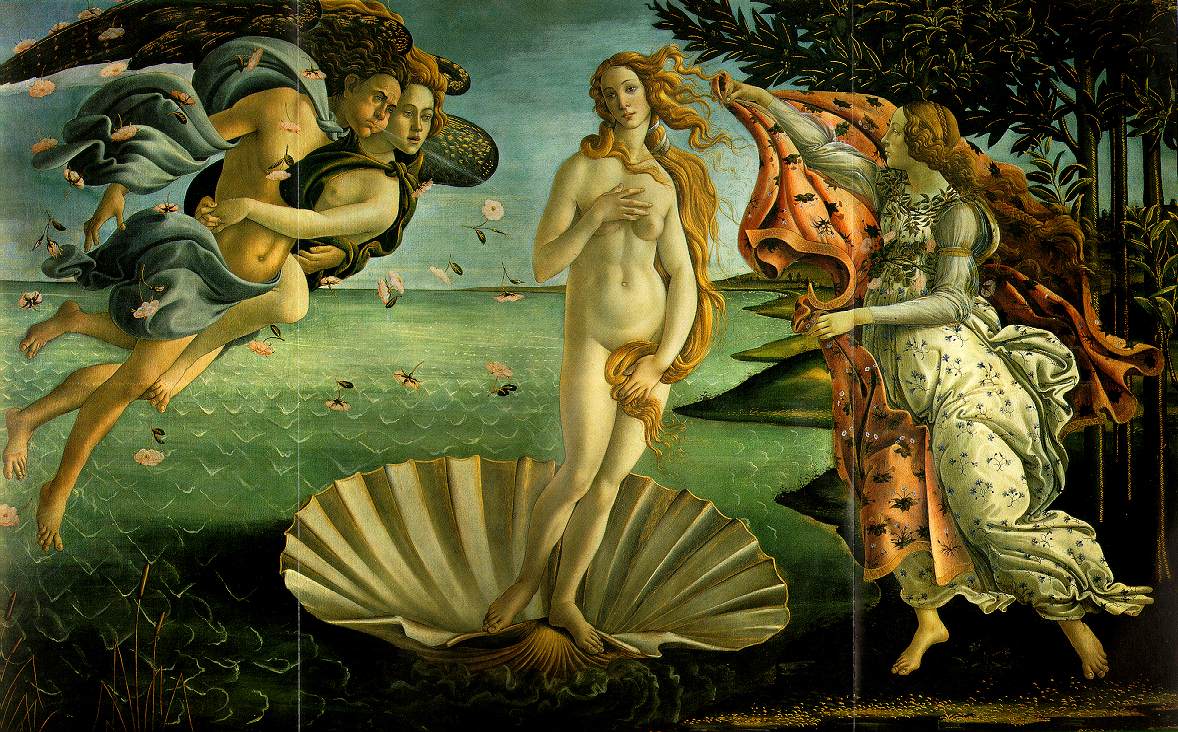
Primavera, (Spring), 1478, is one of the most famous of Botticelli's paintings but you must know Birth of Venus, 1485, that has many reproductions and has been used by some artists as a source of parody or inspiration.
The beauty of both is what first catch the attention. But there is more.
I found Madame Pickwick Art's Blog where there is a very good article about this painting and
you can refer yourself to it to watch details and learn a little more about this painting or just enjoy what you see. Paintings depicting human body can be appreciated even without knowing theirs historical and the iconographical aspects.
As I said some posts ago I'm still having some back problems and must stay away from the computer.
It's being hard to fix attention.
Hope you like Botticelli.
(as always click at the image to enlarge)

Tuesday, December 8

Coke and Botticelli's Venus at the pavement draw with chalk


The coke is another of Julian Beever's work. I have already published two of his works here. The right artist I still do not know the name and found her at The Writing is on the Wall a blog about chalk art and they have some tips for those who want to start this art.
This is Sandro Botticelli's Birth of Venus' detail.
You can see the picture she is using as a model at the photo.
It's amazing!