Showing posts with label Ethics. Show all posts

Monday, November 20

UK lobbying with British tax payers money to steal Brazilian oil

The Guardian
UK trade minister lobbied Brazil on behalf of oil giants

by Adam Vaughan 

Sunday 19 November 2017 16.38 GMT Last modified on Sunday 19 November 2017 22.00 GMT

Britain successfully lobbied Brazil on behalf of BP and Shell to address the oil giants’ concerns over Brazilian taxation, environmental regulation and rules on using local firms, government documents reveal.

The UK’s trade minister travelled to Rio de Janeiro, Belo Horizonte and São Paulo in March for a visit with a “heavy focus” on hydrocarbons, to help British energy, mining and water companies win business in Brazil.

Greg Hands met with Paulo Pedrosa, Brazilian deputy minister for mines and energy, and “directly” raised the concerns of UK-based oil firms Shell, BP and Premier Oil over “taxation and environmental licensing”.

Pedrosa said he was pressing his counterparts in the Brazilian government on the issues, according to a British diplomatic telegram obtained by Greenpeace.

The Department for International Trade (DIT) initially released an unredacted version of the telegram under freedom of information rules to Greenpeace’s investigative unit, Unearthed, with sensitive passages highlighted. Shortly after, the department issued a second version of the document, with the same passages redacted.

Greenpeace accused the department of acting as a “lobbying arm of the fossil fuel industry”.

The UK government denies it was lobbying to weaken the environmental licensing regime, although the lobbying drive appears to have borne fruit. In August, Brazil  proposed a multibillion-dollar tax relief plan for offshore drilling, and in October BP and Shell won the bulk of deep-water drilling licenses in a government auction.

Rebecca Newsom, senior political adviser at Greenpeace, said: “This is a double embarrassment for the UK government. Liam Fox’s trade minister has been lobbying the Brazilian government over a huge oil project that would undermine the climate efforts Britain made at the UN summit in Bonn.

“If that wasn’t bad enough, Fox’s department tried to cover it up and hide its actions from the public, but failed comically.”

The document also reveals that the UK pressured Brazil to relax its requirements for oil and gas operators to use a certain amount of Brazilian staff and supply chain companies.

British diplomats described the weakening of the so-called local content requirements as a “principal objective” because BP, Shell and Premier Oil would be “direct British beneficiaries” of the changes.


The UK’s drive to soften the requirements continued on the day after the meeting between Hands and Pedrosa, with a senior DIT official leading a seminar on the subject at the headquarters of Brazil’s oil and gas regulator.

The UK government has come under fire in the past for providing hundreds of millions of pounds of support for Brazil’s scandal-hit state oil firm Petrobras via the UK’s credit export agency.

The UK’s continued oil lobbying efforts in Brazil emerged days after British ministers were touting the UK’s leadership on cutting carbon emissions at international climate talks in Bonn.


Claire Perry, the climate change minister, told the summit: “we are taking our commitments under the Paris agreement very seriously and we are taking action.”

A DIT spokesman said: “DIT is responsible for encouraging international investment opportunities for UK businesses, whilst respecting fully local and international environmental standards. The UK oil and gas industry and supply chain supports thousands of jobs and provides £19bn in goods exports alone.


“However, it is absolutely not true that our ministers lobbied to loosen environmental restrictions in Brazil – the meeting was about improving the environmental licensing process, ensuring a level playing field for both domestic and foreign companies, and in particular helping to speed up the licensing process and make it more transparent, which in turn will protect environmental standards.”


Brazilian congressman Lindbergh Farias denounces the presence of a Shell lobbyist during
Brazilian Commission. 
"This is s scandal! A Shell representative talking to the rapporteur in the commission?  I'm indignant as a Brazilian. The explicit Shell lobbying. This is a scandal! It is a party for the multinationals! Destroying jobs in our country... "
Lindbergh Farias Brazilian congressman.

I'm also indignant as a Brazilian citizen. 

Wednesday, July 9

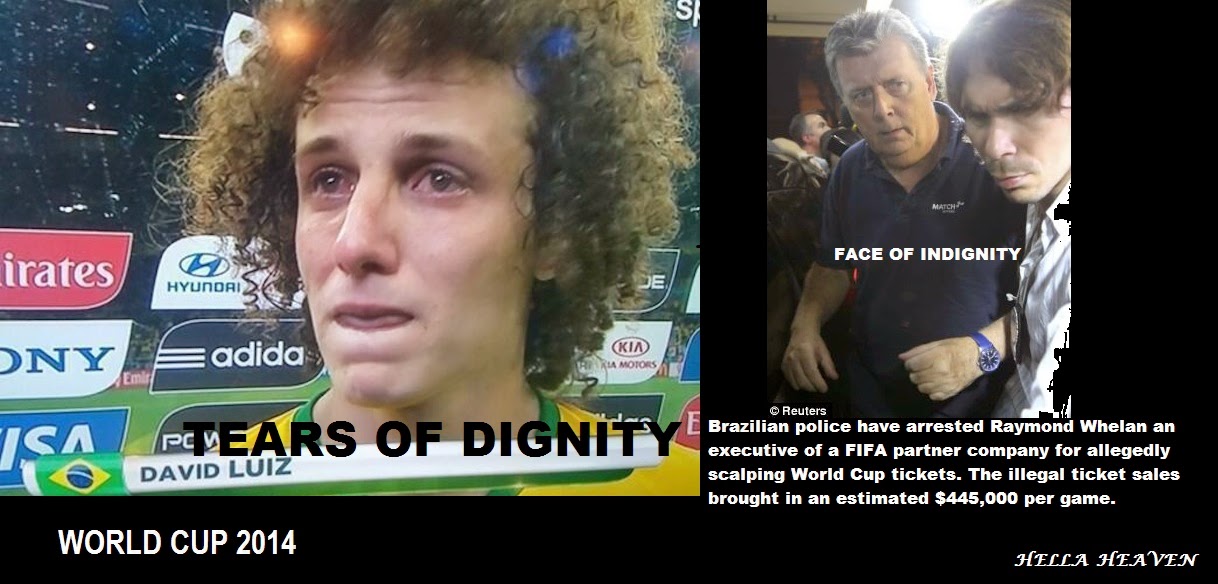
World Cup 2014 humiliation and indignity: Brazil vs Germany match and FIFA's scandal


I've watched the game, you might have watched it too so you now that Germany did 5 goals in 29 minutes and more 2 goals and Brazil only one. The Horror!

Everywhere in the media the words: humiliation and indignity.
It was appalling watching the five goals but even being such a terrible defeat I don't see any humiliation or indignity.
Amazement, sadness, disappointment, anger... but humiliation?

To humiliate:
make (someone) feel ashamed and foolish by injuring their dignity and self-respect, especially publicly.

The shame was not inflicted by Germans.
Brazilians self-inflicted the shame because of the expection of a normal game when the results usually have the numbers 1, 2 and when 3 is achieved it is a surprise.
Nobody lost the dignity and self-respect because something so unusual happened. Till now it is difficult to explain - for some it is easy to point to X, Y or Z but for the vast majority it was unexpected and confusing.

No, it was not an humiliation. It was a historical event because of the number 7 that is for the first time reached in a world cup. But this is part of the game. Just another number to add to the list.

Humiliation and indignity is what FIFA is doing with the black market of tickets for more than two decades.
"The Telegraph" coverage about Raymond Whelan's imprisonment by Brazilian police depict the unscrupulous and criminal fact as an "embarrassment" to FIFA while the defeat of Brazilian team as it was a catastrophe of deadly proportions using and abusing pictures of people crying and full of apocalyptic adjectives.

This is what the mainstream media do all the time: covers up the crimes and exposes what sells and we have to admit that tears sell a lot.

Wednesday, April 2

Rolling Stones lost integrity, ethics and tradition by planning show is Israel


Jerusalem (AFP) - The Rolling Stones announced plans Tuesday for an Israeli concert in June, prompting pro-Palestinian activists promoting a boycott of the country to say that would be equivalent to performing in apartheid South Africa.

To jubilation from the Israeli media, a spokeswoman for the British rock icons said the band will perform in Tel Aviv's Hayarkon Park on June 4 as part of its forthcoming European tour.

But a spokesman for the Palestinian Boycott, Divestment and Sanctions committee noted that the Stones had been vocal opponents of racial segregation in South Africa, saying Israel also practices apartheid.

"Palestinian organisations urge the Rolling Stones to refrain from playing in apartheid Israel and not to condone Israel’s violations of international law and human rights against the Palestinian people,"Rafeef Ziadah wrote.

"The Rolling Stones were at the forefront of enforcing a cultural boycott of apartheid South Africa, but performing in Israel at this time is morally equivalent to performing in South Africa during the apartheid era."

After months of rumours of an impending first-ever visit by the band, which celebrated its 50th anniversary in 2012, Israeli media were jubilant.

"It's official! The Rolling Stones are coming to Tel Aviv," proclaimed Haaretz daily's website.

It said Israeli promoter Shuki Weiss, once quoted as saying he would retire after bringing the Stones to Israel, had guaranteed the band $6.7 million (4.9 million euros) for the one-night stand.

"Israelis finally get some satisfaction as Rolling Stones confirm concert date," was the Jerusalem Post's headline.

"This is a historic and very meaningful visit," it quoted Weiss as saying.

"In these days when we hear calls for boycotts from around the world, it's not taken for granted that a band of this magnitude will come to Israel."

A growing number of governments and international businesses have said they will not trade with Israeli firms with ties to Jewish settlements, highlighting the creeping success of a Palestinian-led boycott campaign.

The movement works to convince them and celebrities to cut ties with Israeli companies active in the occupied Palestinian territories, in a bid to repeat the success of the boycott that ended apartheid in South Africa.

Last week, the Stones postponed their tour of Australia and New Zealand after the suicide of Mick Jagger's girlfriend L'Wren Scott.

But the grieving front man's songwriting partner of 50 years, Keith Richards, vowed that they will soon be back on stage.

Source: Yahoo.


Tuesday, February 11

The war on smoking: Too late to stop smoker's stigma


I came across with this article but I truly believe it is too late to stop stigmatization.
It is amazing how propaganda works and brainwash people in such a way that it borders fanaticism.
I have already heard that "smoking is a sin" not once or twice but many times. It would take another campaign to reverse it all but we know that it will not be done because what really matters is: profiting.


Let's Not Wage War on Smokers
Quitting smoking is good. Stigmatizing smokers isn't.
by Alice Robb

The praise being lavished on CVS in response to its promise to stop selling cigarettes is as profuse as it is predictable. When the drugstore announced last week that it plans to pull tobacco products as it continues to expand into the health care market, doctors, journalists and even the president applauded. “We came to the decision that cigarettes and providing health care just don’t go together in the same setting,” said CEO Larry J. Merlo. "I congratulate–and thank–the CEO of CVS Caremark, Larry Merlo, the board of directors, and all who helped make a choice that will have a profoundly positive impact on the health of our country," said Obama.

CVS’s decision is only the latest in a string of anti-smoking measures that have gone into effect with almost no pushback. In November, Michael Bloomberg’s bill banning the sale of cigarettes to New Yorkers under the age of 21 was met with near-universal support—even though his campaigns against soda and trans fats became fodder for national debates about individual rights and personal freedom. In December, the traditionally smoker-friendly EU voted to implement stricter anti-smoking regulations, including a total ban on the sale of flavored cigarettes.

The lack of resistance to these policies is a reflection of greater awareness of the health risks of smoking, but it’s also a sign of the stigma that’s come to surround cigarettes and the people who still buy them. Tobacco control policies have played a big role in slashing smoking rates—which have fallen from 56 percent of American adults in 1965 to 18 percent today—but they’ve also stigmatized smokers, forcing them to huddle outside public buildings, bars, and now parks. Stigma can be useful if it deters people from smoking, but it can have nasty side effects—like tempting smokers to hide their habits from their doctors, placing an added burden on already vulnerable populations, and making diagnoses of smoking-related diseases embarrassing (on top of life-threatening). Health care officials know this: that’s why they’ve fought to lessen the stigma attached to other conditions and behaviors, from AIDS to depression. “Stigmatization represented a profound psychological and social burden on those with AIDS or HIV infection and it also fuelled the spread of the epidemic,” wrote Jennifer Stuber and Ronald Bayer in a 2006 paper in the American Journal of Public Health. “Yet, in this instance, the concerns about the impacts of stigmatization have been given little consideration.”

Thanks to anti-smoking crusaders, “The fragrant has become foul,” wrote medical historian Allan Brandt in 1988. “An emblem of attraction has become repulsive; a mark of sociability has become deviant; a public behavior now is virtually private.” More recently, psychologists have found that smokers are seen as “outcasts” and even “lepers.”

For a recent paper in the Journal of Social Policy, Professor Hilary Graham of the UK’s York University charted the changing focus of anti-smoking campaigns.

In the US and the UK, health promotion campaigns were initially focused on the risks to the smoker…From the mid-1970s, the risks to others, and specifically to children born to pregnant smokers, were incorporated into government campaigns… Through the 1980 s and 1990 s, smoking was increasingly recast as a threat to the wider public, a shift in public health discourse that was particularly marked in the US.

In 2006, sociologist Hannah Farrimond and psychologist Helene Joffe asked 40 British adults what they thought about smokers. It wasn’t nice.

Non-smokers use terms such as ‘outcast’, ‘persecuted’, ‘lepers’, ‘under-class’ and ‘blacklisted’ to describe smokers’ status in society….Non-smoking participants associate smokers with a strong negative aesthetic. This comprises two aspects, smell (e.g. ‘reek’, ‘pong’, ‘stink’, ‘stale’, ‘old’) and negative appearance (‘stained yellow fingers’, ‘grey, dry, wrinkly skin’, ‘brown teeth’)…several non-smokers see smokers as lacking in cleanliness and engaging in poor self-care.

And in 2008, Stuber interviewed 816 current and former smokers in New York City.

Most respondents agreed that ‘‘Most people would not hire a smoker to take care of their children’’ (81%) and that ‘‘Most non-smokers would be reluctant to date someone who smokes’’ (72%). The prevalence of the perception ‘‘Most people believe smoking is a sign of personal failure’’ (21%) and, ‘‘Most people think less of a person who smokes ’’(39%), were endorsed less frequently but still indicate substantial stigma. The first two items measure social distance from smokers, whereas the second two items are measures of the devaluation of smokers

THE STIGMA’S WORSE FOR LOWER-INCOME SMOKERS

More educated smokers are better at rationalizing their behavior, while smokers of lower socio-economic status are more likely to internalize the stigma. “Smokers’ sense of the social disapproval they face varies as a function of socio-economic group,” Farrimond and Joffe found.

Higher SES smokers tend to challenge the ‘facts’ on which this stigmatization is based, whereas lower SES smokers internalize the stigmatized aspersions…Higher SES smokers also tend to use the pollution metaphor to their advantage to mitigate any perceived blame, by arguing that pollution caused by their personal smoking is equivalent or of lesser impact than other types of pollution…. Higher SES smoking participants also tend to argue that the health risk for passive smokers is relatively low, both in comparison to their own personal risk and in general.

LUNG CANCER PATIENTS FEEL STIGMATIZED—EVEN IF THEY’VE NEVER SMOKED

In 2004, a team of health scientists at Oxford interviewed 45 people with lung cancer and found that felt even more stigma than other cancer patients:

Participants experienced stigma commonly felt by patients with other types of cancer, but, whether they smoked or not, they felt particularly stigmatized because the disease is so strongly associated with smoking… Some patients concealed their illness, which sometimes had adverse financial consequences or made it hard for them to gain support from other people.

In fact, ten percent of lung cancer patients have never smoked, though they may have a hard time getting doctors to believe them: one patient the team interviewed said that doctors refused to believe he’d never smoked, in spite of his own promises and the testimony of his wife.

In a 2008 study published in the journal Clinical Lung Cancer, researchers administered a questionnaire to 172 cancer patients—96 with lung cancer, 30 with breast cancer and 46 with prostate cancer—and found “perceived cancer-related stigma” to be highest in the lung cancer group. “A belief that one caused one's own cancer,” they noted, “is correlated with higher levels of guilt, shame, anxiety, and depression.”


Wednesday, January 22

Rio de Janeiro's Christ the Redeemer statue: lighting strikes twice


The iconic Christ the Redeemer statue in Rio de Janeiro will undergo repair work after a bolt of lightning damaged one of its fingers and its head.
Its right hand had been damaged sometime ago, but the finger finally broke off in a storm late Thursday.
You can read the news here.
We Brazilians are scary because will have the games and Olympiad in 2016 and as CIA is at the country manipulating people to make protests that has violent actions, just like they do in many countries, the possibility of a terrorist attack or any other false flag operation is being considered by those who know Washington's foreign policy.
It is obvious for some people that they'll not let this opportunity pass.
This pictures are quite spectacular, aren't they?


Thursday, September 19

East Ghouta debunked by Mother Agnes: US lacks moral, dignity and ethics


Mother Agnes Mariam is a Carmelite nun who has been living and working in Syria for the past 19 years. Now, she is seeking to set the record straight on the lies and disinformation that is driving the NATO powers toward war against the people of Syria.

Mother Agnes and the International Support Team for Mussalaha in Syria (ISTEAMS) wrote a report about the Chemical Attacks in East Ghouta with detailed analysis of the videos.
But even a layperson can reach the same conclusions. US has crossed all lines and there is not a shred of dignity, integrity, ethics and moral left in those who are involved in all these heinous crimes to promote the Zionist agenda to destabilize middle east.


"Since the moment where some families of abducted children contacted us to inform us that they recognized their children among those who are presented in the videos as victims of the Chemical Attacks in East Ghouta, we decided to examine the videos thoroughly."

"Our first concern was the fate of the children we see in the footages. Those angels are always alone in the hands of adult males that seem to be elements of armed gangs. The children that trespassed remain without their families and unidentified all the way until the burial. Moreover, our study highlight without any doubt that their little bodies were manipulated and disposed with theatrical arrangements to figure in the screening."

"Thus we accuse the editors of the videos of artificial scenic treatment of what should have been honest information footage. The cynic manipulation of the little inanimate bodies that seem to be under anesthesia, endangered the life of the children and raises our minds the question of their safety and the real reason of their death."

"If the studied footages were edited and published to exhibit pieces of evidence to accuse Syrian State of perpetrating the Chemical Attacks on East Ghouta, our discoveries incriminate the editors and the actors of forging facts through a lethal manipulation of unidentified children. Thus we want to raise International Awareness toward the humanitarian case of this criminal use of children in the political propaganda of the East Ghouta's Chemical Attack."

"We present this work to distinguished Spiritual Leaders, Head of States. Head of Delegations, Senators, Members of Parliament, Humanitarian actors and to any person that has a heart for truth and justice and that seeks the due accountability for evil deeds." (read it here)


Saturday, March 30

American Film Institute's dangerous connections

I was browsing the AFI site just to find out that without the sponsor of corporations the movie industry would have not a single party. Take a look on how stupid our favorite actors and actresses look when they are at the red carpet here.
If you did click at the link you saw the smiles and the poses celebrities, yes, they are turned into "celebrities", have to do. Just like a zoo.

These are some of the corporations:

"As part of its continuing effort to increase awareness and appreciation of American film history, AFI's 100 Years...100 Laughs is supported by an AFI website, in-theater trailers and a video retail program which launches today. General Motors, Blockbuster, U.S. Postal Service, Warner Bros., Pepsi, Anheuser-Busch, 20th Century Fox, AT&T, Johnson & Johnson, Merck, Paramount Pictures, Universal Studios and Walt Disney Pictures are sponsors of AFI's continuing commemoration of the centennial of American movies." (emphasis added)

I still don't know what to think. Fortunately we are having access to movies from others countries lately at the TV which is great because it makes people have other influences.

What happened to the American dream? The Clinton-Obama era turned things upside down. Sad times.
Corporations are killing the Americans and the American culture has changed.
"I am _______ and I am an AFI member." actors and actresses are saying in one of the promotional movies at the AFI site.

Wake up America!

I'm gonna watch a Carlos Saura's movie now.


Friday, July 6

R. D. Laing On DSM-3: the project of homogenization of experience


This is a three minutes video and it's worthy every second because it talks about our normal experiences of life being considered as mental disorders. There are two parts and the second is about the "psychophobia". At the beginning he tells a very funny story about a psychologist that asks if... watch the video.
 I just did transcript these excerpts:

"One characteristic of our culture I think it is a, what I call "psychophobia". Psycophobic... we are frightened of their own minds, of our own psyches.

There is no other book going arond that is more explicit about it than the DSM-3 "Diagnostic Statistical Manual of the American Psychiatric Association 3rd edition which calls itself as a compendium of criteria for mental disorder.

Any unsual perception experience is a criteria for mental disorder... any unusual perception...

I feel the presence of a dead person who is not there. You're allowed to do that for three weeks after your mother dies. After that it is a criteria for mental disorder.

what seems to be a massive project of  homogenizing experience. We are all experiences at the same time

nobody will gonna be allowed to experience diferently, diferent from any one else. It's not allowed to see the sky as grey if other people see as blue.  ...
Blue, grey, white? There is only one answer.
Image: roujo at Flickr


Friday, June 15

Columbine victim: Mark Taylor locked up to be drugged and remain silent

 Interview with Mark's mother Donna Taylor.
Listen to internet radio with MedicalWhistleblower on Blog Talk Radio

The lawyer Wesley Hoyt is working for families of Columbine.
After the shooting, Mark had extensive hospitalization and was in and out of the hospital three times. The traumatic memory of that day will always remain with Mark Taylor.

Why is meek and mild Mark Taylor locked up and the Arizona shooter, Jared Loughner, allowed to run free based on HIS “Constitutional Rights” and commit mass murder???

This is our most comprehensive expose yet.  It ties the current illegal confinement of Mark Taylor in an Arizona mental hospital with an extensive re-edit of videos regarding the Bomb Warrant, The January Incident and the ensuing coverup.  On one of the videos, the news helicopter pilot is relating how the FAA was closing his air space even though he was three miles away!  Next up the “Roof Top Shooters” and why Mark is being persecuted and tortured.


 Mark Taylor is a victim several times over:

  1. The shooting and lying there for two hours with bullets whizzing around him while he was bleeding from nearly a dozen bullet wounds.  Some bullets remain embedded in his spine and near his Aorta.  Because of the way the bullets ravaged Mark’s body, it was impossible for the surgeons to count the wounds.  The estimated bullet count ranges from 8 to 13.  Miraculously, he had a full recovery, went on a book tour, testified before the FDA and was interviewed on numerous television broadcasts.  Now he’s been declared an “incapacitated person.”  WHY ?
  2. Mark has been illegally detained and drugged TWICE now, this time for over a year.
  3. Michael Moore has forgotten to send his check to Mark for his part in the movie.
  4. The “government” of Arizona is committing multiple crimes including violations of Mark and Donna’s Freedom of Association, Guarantee of Counsel along with their fundamental Human Rights.  etc….

Now, under the best of circumstances, Mark faces one to two years of recovery and may never fully recover from the continued misuse and abuse of psychiatric medications.
Mark has been imprisoned illegally and the “Government of Arizona,” violating so many of Mark and Donna’s Constitutional Rights that I am too tired to list them all, but, I assure you, I’ll have them up on this site shortly, well, actually, they are lengthy, appallingly so! Of course, I may just be uneducated; maybe there is a logical explanation for this foul-up."

Source: ColumbineFamilyRequest.org. Wesley Hoyt is a private investigator who volunteered for  several Columbine families who are still trying to heal from the shootings on April 20, 1999.  "Why won’t Columbine heal?" he asks.

Donna Taylor: "Mark and I was interested on finding out why did they did the shooting. The other part of it is that they were drived... these boys were  the best kids in the school until they were messed up with drugs and they became a nightmare.
They were very friendly... listen to the interview.


Friday, May 25

Tzvetan Todorov interview to Seji Doria


"Exile enables you to observe your own habits critically, and to be able to diminish their importance when you live in a different society."
Tzvetan Todorov

I have the pleasure of having Tzvevan Todorov, who fled to Paris from the communist Bulgaria in 1963, again at this blog. Now I see how lucky I was having so many good theorists as masters even if at that time I did not consider them as such.

As I studied Literature in the end of the seventies and beginning of eighties I had a bunch of philosophers, linguistics, social scientists, psychoanalysts even literature scholars and theorists and art historians to choose. I did read some and others I ignored following a choice that is hard for me to explain.
But those who really counted were the artists and writers. They are part of who I am and some thinkers too for I choose some that talked to me more closely.

Todorov is one of them for he studied the fantastic in literature. His interviews are amazing and he talks with a smile in his eyes and concern in his forehead. Sometimes I watch what is at YouTube and I feel... I don't know how to explain. Maybe it is because he speaks in French and talks in French in discussions and as I lived in Paris and had a group of French thinkers in Brazil I used to participate it must give me back a territory I like. "It's through fear that the most unacceptable actions are carried out." he claims and defends that Europe should create a "peaceful power" a military action to protect contre attacks. "I'm not a pacifist." says the man who criticized his Marxists friends of living a bourgeois life trying to implement the proletarian dictatorship a regime that suppress civil liberties.

In an interview to Seji Doria, who brightly conducted the interview in June, 2010, published at Barcelona Metropolis Todorov portrayed a panorama of his experiences of life and thoughts.


In 1963, you fled to Paris from communist Bulgaria, and three years later you obtained you doctorate at the Sorbonne with Roland Barthes, you joined the Centre National de la Recherche Scientifique (CNRS) and for ten years, you were the co-editor of the journal Poétique with Gérard Genette. What contribution did structuralism make to literary reception?

Todorov: At that time, it was a more refreshing perspective on literary studies. The approaches to literature in France were sterilising, asphyxiating. Specialists were asked to compile all the details about the writer being studied. Life, work… a mere accumulation of facts: biography, the conditions under which he wrote his novels, the different versions of them, the entire body of criticism that covered his works. It was a historicist criticism that insisted on placing the work of an author in a specific context, without paying too much attention to what it wanted to say to the readers. As a result, we couldn't say why it was still a pleasure to read Madame Bovary or Le rouge et le noir in the 21st century …

And that was your methodological starting point…

Todorov: It based criticism on interpretation of the text, and not only on its historical context. Structuralism enabled us to shed light - forgive the repetition - on the literary structure with more precision than had been the case previously – to renew different forms of meaning and rhetorical figures. To learn that narration provides us with various techniques and constants in the construction of the classic novel, the modern novel, etc. All this was possible thanks to the studies of the “Poetica”, an expression which refers to its Aristotelian meaning and which analyses the work from the interior. We were doing what Proust mentioned in Contre Saint-Beuve, or the lessons by Paul Valéry at the College de France. It was a complete innovation with characteristics that had never before been considered in literary work.

But all schools or currents of thought triumph over the previous ones, and create a pendular motion that leads to excesses. By analysing the mechanisms of the work in itself in such depth, we end up forgetting about the readers' enjoyment. Several generations of students of generative and literary grammar remember structuralism as a nightmare, and you accepted the blame.

Todorov: Looking at the programmes in secondary schools, I wondered over the years whether we had really achieved anything with the change. The teaching staff forgot that structuralist techniques should have helped to understand the work rather than being a simple sequence of analyses. Students prepare for exams knowing about “Jakobson's functions”, analepsis and prolepsis, and what a metonymy is without having read Les fleurs du mal (by Baudelaire). As I explain in my book Literature in danger, these arguments mean that I am currently inclined towards a conception of literary studies that follows the model of history rather than of physics, which tends towards knowledge of an exterior object, literature, instead of focusing on the mysteries of the discipline itself ... There is no doubt that readers will continue to know who Rousseau, Stendhal and Proust were, long after they have forgotten the names of today's theoreticians and their conceptual constructions, so teaching our own theories on the works instead of the works themselves shows a certain lack of humility.

In Literature in danger you discuss the teaching in French schools. You say that literature has distanced itself from individuals since the Enlightenment …

Todorov: Literature is profoundly linked to understanding the human condition… The books that attract readers do not do so for scholarly reasons, or rhetorical considerations, but because they help them to live. It seems that the only objective in schools today is to train literature teachers, which I think is absurd. It gives the impression that artists draft their works thinking of critics, as is the case with conceptual art. And the literature that the general public reads is often not the same as the one that interests scholars. The most influential groups control state subsidies and shape public opinion based on literary criticism and educational programmes.

Let's go back to 1963: Todorov was in his twenties, and was involved in the French university atmosphere. Camus was dead and Sartre reigned. What did they think of the testimony of an exiled Bulgarian who criticised the supposed communist paradise?

Todorov: Let's say that when I arrived in Paris, Sartre's star began to wane. And it burnt out in his public debate with Lévi-Strauss: in intellectual circles, there was no doubt that the author of Tristes trópiques had won on points. Marxism, which had been the framework for the human and social sciences and humanities since the Second World War, was replaced by structuralism in the 1960s. Things weren't so black and white in everyday life: young people, the girls I went out with, were left-wing and their rhetoric was based on fantasy. They sincerely thought that I came from paradise, and that they lived in hell. They didn't acknowledge the existence of Stalin's labour camps, or the corruption of the communist governments.

The European left, and the Spanish left in particular, continues to have great difficulties with categorising Nazism and Communism as equally mistaken.

Todorov: That difficulty exists, and it is understandable. The countries of Western Europe suffered from Nazism but not communism, while in the east we suffered from both types of totalitarianism. As we have first-hand knowledge of the cruelty of Nazism and Communism, we have no doubt that they were both similar types of phenomena. In Western Europe, where the Communist party didn't govern, communist militants were seen as selfless and generous individuals - like Catholics who had lost their faith and did charity work by helping others. It all depends on your point of view. That is why it is difficult to have a common memory in Europe.

Recently, we saw the 70th anniversary of the invasion of Poland: in the schools, they remember the soldiers of the Nazi Reich and not the Soviet soldiers, who also invaded under the Ribbentrop-Molotov pact.

Todorov: History teaching should enrich the collective memory by raising awareness of the different experiences of the European countries. It is necessary to understand why the Poles do not have the same perspective on the Second World War as the French, Belgians and the Dutch. The invasion by Hitler and the invasion by Stalin are rarely associated. And the period between 1939 and 1941 was the turning point in the history of the twentieth century. It was the undistorted truth of totalitarianism as a key and specific event. The rest of time is an illusion. After the war, the Soviet Union presented itself to the world as the sacred victor over Nazism, with 25 million soldiers killed. Europe paid a high price for the debt, and the Russians occupied Berlin. From that point on, suggesting that the Soviet concentration camps had preceded the Nazi lager seemed like a comment in poor taste.

And from that point until the fall of the Berlin Wall.

Todorov: Watching the fall of the Wall had a profound historical impact: it was the first irreversible sign of the collapse of communism. The dismemberment of the USSR, which followed ten years later, shifted this event onto the international stage. Communism marked European history and has been the great secular religion of the modern age, the focus of the part of history for one hundred and fifty years. Like the traditional religions, it promises its followers health; but because it is a secular religion, it says this will happen on the earth and not in heaven, in this life, and not after death. It thereby appeals to millions of people immersed in poverty and injustice, who are no longer consoled by the promises of the old religions. It suddenly becomes an ideological proselytism, capable of using violence: the class struggle has to be won in every country; it is necessary to spread the good news from one country to another, and to encourage the establishment of communist regimes. Humanity will gradually "benefit" from the fruits of this red messianism.

Some leaders of the European left and Spanish communists still do not understand, and were reluctant to celebrate the anniversary of 9 November 1989. They say that in the democratic world, since 9/11, control mechanisms and preventive detentions have greatly increased …

Todorov: Being surprised or ironic about the fall of the Wall seems to me to be an insult to those who suffered from it. The democratic societies are light years away from the control by the Stasi or the State Security in Bulgaria. Being watched by a powerful totalitarian system should not be confused with errors in the democratic system, which need to be remedied. But to compare the two situations on the same level is to overlook the suffering of millions and millions of people.

After the fall of the Wall, what world do we have left?

Todorov: We went from the confrontation of two great powers in the Cold War to a multipolar world. Some people believed that we were going to live in a unitary universe led by the United States, but in the end the East-West confrontation has made way for other political models. This situation was unprecedented, although I believe it is positive that countries from all over the world can also write history.

And other walls are being built …

Todorov: Men have built walls since antiquity: Alexander the Great, the great Wall of China, Hadrian's Wall in the Roman Empire. Wall of protection against possible invasions. With the passing of time, military defences have been abandoned as technological progress has made them ineffective. These walls are still currently being constructed between Morocco and part of Mauritania; but these protection barriers are normally smaller: around a barracks as in Baghdad's Green Zone or around a neighbourhood with a bad reputation in Padua.
Another type of wall is protection systems for deluxe homes, the separation between the two Koreas, or between India and Pakistan in Kashmir, or the partition of Cyprus between Greeks and Turks. The Berlin Wall belongs to an unusual category. While most walls aim to stop foreigners from coming in, the Berlin Wall aimed to stop the country's inhabitants from being able to leave. It was not used to protect people. Instead, it was used to make them ill. The symbolic image is one of a prison rather than a fortress. When I lived in Bulgaria in 1963, no inhabitant could cross the frontier without permission: the security patrols shot to kill. Telephoning abroad was inconceivable, you couldn't read foreign press that wasn't communist, and foreign radio stations broadcasting in Bulgarian were jammed.

We also have the Wall in Israel and the barbed wire against immigration in the strait between Spain and Morocco.

Todorov: It is surprising to see how walls are being built in the era of so-called “globalisation”. In reality, it is no paradox. What are in free circulation today are goods and capital, audiovisual information and electronic messages. But the circulation of people from poor countries is regulated.

As well as physical walls, it is also possible to talk of “walls” in language: in the communist countries, they used the “doublethink” and the “Newspeak” that Orwell described in 1984.

Todorov: Life under communism erodes the spirit, by systematically using words not to designate things, but instead to conceal their opposite. When our leaders talked about equality, we could be sure that they wanted to protect their privileges; praise of freedom covered up oppression, proclamations of peace warned of acts of aggression, the defence of the common good could be interpreted as the opening of a personal account in a Swiss bank …

And the politically correct language and euphemisms with which democratic governments cover up their errors… are they not a dangerous strategy to conceal reality?

Todorov: Demagogy and manipulation of the word are as old as politics. Plato condemned the Sophists who concealed their actions using words. He attacked rhetoric and all use of language that was not referential. We have figures of speech like hyperbole and litotes, which expresses a concept by denying its opposite. The totalitarian neolanguage is antiphrasis, using a word to mean the exact opposite of what is being said: it is the lowest level of deceit in language. Of course they can create obstacles to free thought, based on cliches and stereotypes, but a physical wall is equivalent to prison and is much more serious than a language barrier.

The "conversion" to democracy of the ex-communist countries has been affected by what the Romanian writer Norman Manea llama called the "slow poison" of the old totalitarian regime, which still contaminates politics in Eastern Europe ... Václav Havel referred directly to "Mafia democracies".

Todorov: Indeed, this transformation of all values which we have talked about, the concealment of their opposite, was confirmed with the fall of communism, as the leaders, or their descendants, or the ex-chiefs of the KGB, became the first "capitalists", the owners of privatised companies and experts in lucrative dirty tricks. Their conversion to democratic rhetoric and the habits of personal accumulation of wealth was immediate, and shows that their metamorphosis was already at a very advanced stage when the time came to change the system. Putin is the most obvious example of this strategy.

I mentioned “red messianism” earlier. Since the defeat of communism, as any other free market messianism emerged?

Todorov: From a historical perspective, Communist messianism appears to be a variation and a transformation of an older secular messianism, which emerged with the French Revolution and today reappears under other guises. We know its previous phases. It came immediately after the Revolution, spread with the Napoleonic Wars, and its ambition was to save humanity in the Century of Enlightenment. A few decades later, it took the form of the colonial conquests by Great Britain and France, which aimed to bring civilisation to all … Since the fall of the Berlin Wall, a new type of this old messianism has reappeared. In the name of spreading democracy and human rights, the Western countries, this time led by the United States, make alliances for wars against countries that are strategically and economically important - yesterday it was Iraq, today Afghanistan, and tomorrow it could be Iran. The Western forces justify themselves using the backward customs in these countries (the imposition of the veil on women, the closure of schools) or their hostile political attitude ("Islamofascism") and bomb them, occupy them and impose compliant governments on them.

Is this another drift towards totalitarianism?

Todorov: Another example is the legalisation of torture. Torture took place on an everyday basis in the totalitarian states, and it was even a basic part of their survival, but they never legalised it. The West must resist the temptation to torture legally.

Many neoconservative leaders and ideologues in ultraliberal think tanks come from the extreme left …

Todorov: The neocons, the ideologues of military intervention who are legitimated by their defence of human rights, are the descendants of the old communists, who over the years have become ardent anti-totalitarians (first from a revolutionary Trotskyite perspective, and then from a democratic one). In France, the same people were involved in all three stages: they were the standard bearers of the communist religion in 1968, in one of its strands of the extreme left; then they became radical anti-communists and later anti-totalitarians, after the extensive reports on conditions in the Gulag became common knowledge (at this point that they were christened the “new philosophers”); and finally, in recent years, they have emerged as supporters of the “right to intervene” and “democratic” war in the rest of the world. The modern forms of neoliberalism shares some features of communism, perhaps precisely because they fought against it...

And what do they have in common?

Todorov: To some extent, a monist thought process, the desire to reduce the complexity of the social world to a single dimension, and subject it to a single force. There is also the separation between politics and economics. The autonomy of economic action was called into question by totalitarian power, which prioritised politics, with the well-known consequence of empty warehouses and permanent shortages. Now it is political autonomy that is weakened. Globalisation enables the actors in economic life to easily avoid the control of local governments: at the first obstacle, the multinational company "relocates" its factories to a more welcoming country.
Inside each country, ultraliberal ideology leaves no significant space for political action. In one way, this change is even more profound than the one caused by the French Revolution. The French Revolution was content to replace monarchical sovereignty with that of the people, and neoliberalism places solvency of economic forces, embodied in private interests, above political sovereignty. It is necessary for governments and parliaments to refocus their policies in order to achieve the common good for their citizens.

The political class, in Spain at least, is not experiencing one of its high points. After the death of the utopias and the great systems of thought, will we be able to live without ideologies?

Todorov: Human beings in Western Europe show us spectacular changes: from communist faith to ferocious anti-communism; in France, from Marchais to Le Pen… But it is also possible to maintain a critical distance from all types of faith and mental submission. Ideology should not be thought of in terms of the submission of others because they are simple or ignorant, while we ourselves believe that we are not subject to it and have a great deal of common sense. Individuals need a system of thought, although it is a good idea to keep some distance from this system. Exile enables you to observe your own habits critically, and to be able to diminish their importance when you live in a different society.

Let’s finish off by remembering "Adventurers of the absolute", three existences defined by cosmopolitanism: Wilde, Rilke and Marina Tsvetaeva. It is a biographical triad that is a tribute to the great European Stefan Zweig.

Todorov: Zweig was seductive and dangerous. Seductive, because he talked to his readers using a global idea, because he established a continuity between the writer, the work and moral destiny, because he was a true European. He was dangerous, because of his romantic demand that life should be sacrificed to art, a concept which inevitably leads to tragedy.

Sunday, April 29

Making profit out of cancer: American Cancer Society

There is no other word for profiting from diseases and making people sick by prescribing drugs which risks overweight the benefits: crime.
That's why omnipresence of the consortium that profits at the expenses of sickness always amazes me.
I have seen many times people defending them in discussions in social networks and blogs of people who raise awareness of the way medicine is being dictated by pharmaceutical industry.
The third cause of hospitalization in USA is iatrogenesis: disease caused by the treatment, mostly prescribed drugs.

When I joined Second Life I was advised that the pharmaceutical industry was there by a woman who was part of a sort of PETA's group.
I  joined a group that allegedly helps depressed people and another a kind of suicide hot line. 
When someone asked for help about Paxil/Seroxat withdrawal I answered and... I had the honor of having been banned from the group because I raised some issues about withdrawal and some facts that the pharmaceutical industry doesn't like to see discussed and try hard to keep covering up.
One can write numerous arguments but will be silenced not receiving answers but being labelled conspiracy theorist, scientologist, troublemaker and whatever suits. 

For the whole month this advertisement - click at the image to enlarge - were at the login page of Second Life. The money donated  is for one of the wealthiest non-profit institution: the American Cancer Society.
According to them: " Relay For Life is the signature fundraising event of the American Cancer Society.  The Relay For Life of Second Life is the largest, most successful fundraising event in the virtual world, raising more than $1,200,000 since its first event in 2004." (emphasis added)

The famous institution, that at first glance advocates for cancer patients, has ties with the pharmaceutical industry and has received many critics being  Dr. Samuel S.Epstein*, M.D. one of the most active.
He explains at this link what the American Cancer Society really does.


The ACS's indifference to cancer prevention reflects major industry funding. ACS has received contributions in excess of $100,000 from a wide range of "Excalibur Donors," many of whom continue to manufacture carcinogenic products. These include:

•Petrochemical companies (DuPont; BP; and Pennzoil)
•Industrial waste companies (BFI Waste Systems)
•Junk food companies (Wendy's International; McDonalds's; Unilever/Best Foods; and Coca-Cola)
•Big Pharma (AstraZenceca; Bristol Myers Squibb; GlaxoSmithKline; Merck & Company; and Novartis)
•Biotech companies (Amgen; and Genentech)
•Cosmetic companies (Christian Dior; Avon; Revlon; Elizabeth Arden; and Estee Lauder)
•Auto companies (Nissan; General Motors)

 Cancer Prevention Coalition is the best place to search for guidance about cancer. 

Samuel S. Epstein, M.D. is professor emeritus of Environmental and Occupational Medicine at the University of Illinois at Chicago School of Public Health; Chairman of the Cancer Prevention Coalition; The 2005 Albert Schweitzer Golden Grand Medalist for International Contributions to Cancer Prevention; and author of over 270 scientific articles and 20 books on the causes and prevention of cancer, including the groundbreaking The Politics of Cancer (1979), Cancer-Gate: How To Win The Losing Cancer War (2005), and Toxic Beauty (2009, BenBella Books).

Monday, December 12

Coat fur discussion: what do you think about it?

Fur coats are not only a fashion issue and many topics were raised about them.
Focus on those issues you care the most.
Some trigger topics for discussion if you don't have anything in mind:
Would you wear this coat? It is warm since it is done of wolf's fur. The hunter wears it. Maybe it is appropriate when hunting in cold weather.
I'm puzzled:
"I rather go naked than wear fur."... but "I do nothing to stop the massacre of human beings".
What do you think about fur coats? What about the prices?
Would you wear faux fur? Wold you buy this one that costs $9,995.00 but is on sale for $4,995.00?
Do you think that if the animal is not in extinction it is ok to kill animals to make fur coats?
Leather has a different ethics than fur?
Shoes made of leather is acceptable since the synthetic leather has improved and can adapt to the feet just like real leather?
What about bags made of leather?
Please, feel free to ad your own issues about fur coats. There are lost of questions involved.
Thank you!

Monday, November 28

Help! I need to change my dog's diet to homemade. Anyone already did that?


I'm feeling stupid and blaming myself for giving nothing more than processed food to my dog as the vet who was her owner told me to do ten and a half years ago. I bought the most expensive and was sure that it was the best I could do for her.
Wrong! She is with a liver problem and this are the scary numbers:


ALT = 282,00 > normal range of 5.00 - 82,00 (UI/L)
Alkaline phosphatase = 704,00 > normal range 20,00 to 150,00 (UI/L)

The ultrasound test is not better and the worse is that she has a severe hepatomegaly (liver gets larger).

She is fine and asymptomatic and is only sleeping more profoundly and for more time. She is not coming quickly as she used to do.
But she is already an old lady so I believe that changes will be happening and it is normal.
I have started to change her diet by adding rice to the processed food and I'm planning to little by little take stop giving her the poison that Royal Canin is producing and we pay crazy amount of money.
I talked to a biologist that lives next to me and she told me that these processed foods are poisons.
I did some research and found some sites.
I just don't know what am I going to give her. I don't wanna go to any vet because I simply don't trust any and had a very bad experience with this one and two others that I described at this post.
I'm giving her a little bit of my own food.
Yesterday I did put the processed food without the rice and she didn't eat. She loves rice, always did and how I wish I had talked to my friend earlier but physicians are those we talk about health, isn't it?
Vets are receiving money to prescribe the processed food just like those human physicians receive from the labs.
I'll search and ask some advises to those who have animals but are smarter than me and give homemade food to their dogs.
I cannot take the $Royal Canin$ cold turkey because she'll have a serious diarrhea and even bleed as it happened once when she was fed with another of these processed food.
If you have any advise I would love to listen.

I just found this site and these the list of side effects of one of the ingredients of Dog's Processed Food:

"Although you won't see it on the label, since it is often added at the rendering plant and not by the manufacturer, ethoxyquin (EQ) is used to preserve most dry dog food. EQ is the most powerful of all preservatives and may be the most toxic.

Rendering plant workers that have been exposed to it denoted side effects similar to those of Agent Orange:

* A dramatic rise in liver or kidney damage
* Cancerous skin lesions
* Hair loss
* Blindness
* Leukemia
* Fetal abnormalities
* Chronic diarrhea

In animals, EQ has been linked to:

* Immune deficiency syndrome
* Spleen, stomach, and liver cancers
* And a host of allergies
Stop feeding your dog or cat with poison. Don't do what I did.
This is another great article:

"“We are seeing disease conditions in animals that we did not see years ago. Many of these may be traced to nutrition as the source…” Don E. Lundholm, DVM
Dr. Kollath, of the Karolinska Hospital in Stockholm, headed a study done on animals. When young animals were fed cooked and processed foods they initially appeared to be healthy. However, as the animals reached adulthood, they began to age more quickly than normal and also developed chronic degenerative disease symptoms. (...)" (emphasis added)
Update: January, 2, 2012
I noticed that the first link has some items to sell. I didn't buy them and do no intend to and used this link because of the list of the diseases. I was nervous and didn't check if there were advertisements.
I don't buy any food to my dog now. It is all homemade.

Wednesday, October 12

Veterinary aims profit just like medicine


Last week I said that my dog would have surgery but it was cancelled.
As I know what medicine is doing to human beings so I started searching for veterinary and it is the same: money speaks louder than health.
I am suspicious about the vet and will have to find someone for a second opinion.
I am very frustrated, sad and angry* because it is outrageous to live in a era where you cannot trust health professionals.
When greed is above health I don't know...
Be careful when your pet needs treatment and don't give them vaccines because the side effects are also not informed just the way medicine is doing to humans.
Update:
* I'm very, very angry!!!!!

Update: 10/13, 2011
I went to another vet and I was right. She has one tumor on her head and others at her body but the only one that needs to be removed is the one on the head.
She is already 12 years-old and the other tumors must not be removed because it would cause an imbalance that would make other tumors appear.
The anesthesia will be a light one that last only for the time of the surgery.
Bottom line: trust your instincts and ask for a second opinion whenever you feel that something is not right.
We usually think that we are being judgmental and it is all in our heads.
No! There are good and bad professionals and our instincts work very well in revealing the bad ones once we have the knowledge that medicine and veterinary don't care about health.
Search for the good ones.

Tuesday, April 26

Bloglovin: using blogs to sell

I misspelled the name: It is BlogLovin, the application for fashion victims below, and not the way I first wrote.
Why they didn't write FashionLovin since blogs are not their forte? Update: April, 27 They keep publishing my posts as you can see at the first left image. Dear Lord! These people really need desperately other people's work! Be careful with these kind of scams. There are many at the web! Update: April, 28 I just found an article also explaining how Bloglovin steals content even from bloggers who didn't sign. This is criminal and there's no other word for that.
The first image I just took from their site showing that they keep using my posts and have the one I did four hours ago.
Isn't it amazing how they need people's work? But the lack of integrity and ethics is not a surprise and there are so many people doing
Say NO to unethical marketing
the same! They forget that I use work of many people, attributing of course, but if they publish their images without giving the attribution for the creators they have another problem.
What is amazing about those who steal people's work is that they never achieve their goals and their projects are never taken seriously or are profitable.
Funny because once you are willing to make things the wrong way it is so much easier to succeed in our days and in history we also have some examples.
But you have to do it wisely and let's face it: stealing from bloggers is not in the mind of a great marketer or a man of broad visions.
Poor people. But it's an advice for bloggers who are not very known and might be very upset when things like that happens.
It means nothing. Just don't let them steal your traffic. Tips in another post.
Update: June, 17
Blogovin is still using my blog. The image shows my last two posts for today.
I don't think we can teach ethics or respect to anyone.
I will not even talk about integrity, rules and all these words.
Only respect. I wrote them saying I had unjoin their site and asked to have my blog removed.
They don't do it.