Have a nice Friday and... be safe.
Friday, July 16


Thursday, July 15
The Death of Socrates, 1787, and the French revolution
 I have already published a post about this painting but I know nobody saw the video. The site Smarthistory is very good and has this video about the painting.
A dialog between a man and a woman goes slowly giving you a very good explanations about historical facts.
Here are some of the ideas they share:
"In 1787, just two years before the French revolution Jacques-Louis David, a very active painter in the revolution itself , presented "The Death of Socrates". Socrates, the Greek philosopher professor, is this figure in the center pointing up and was sentenced to death accused of corrupting youth's mind of Athens. Socrates urged them to think for themselves and to question everything. This is also the spirit of enlightenment. Socrates could admit that he was guilty and renounces teaching or he could die and the way he choses it is to drink kylix, that poison. Look at the emotion spectrum of his followers.... The only figure that seems to be at peace with this decision is the figure at the foot of the bed, and that would be Plato..."There is more at the video and I hope you listen to it and go to the SmartStory to check if they have something about any of your favorite painters.
Wednesday, July 14
July, 14 the French National Day and the function of women's brain
"This is how our brain works... WE WOMEN...
It's not complicated as it seems.
Read the explanation above the image:

(click at the image to see with white background)
Every blue ball represents a thought about something to be done, a decision or a problem to be solved.
And what about the man's brain?
Well, the man has only 2 balls to handle and their thoughts are focused only on both of them."
Today is the French national day and there are many controversies about how the day was celebrated. I do not want to think of this day as a political issue but as a celebration of the French cultural patrimony.
I just found the post above at Sophie's blog EurekaSophie and this is my homage to what this day means to me.
Thank you Sophie and those French who are creative and follows a heritage that makes Franch such an amazing people. They created camembert! That is enough! Vive la France!
Tennyson's poem "The Lady of Shalott" depicted by John W. Waterhouse
 This is very known painting and maybe you have already saw it but does not know what it represents and who is the painter. He is John Williams Waterhouse who did this work in 1888.
This is the text of the Tate Gallery, where it is now:
"This painting illustrates Alfred Tennyson’s poem The Lady of Shalott. Draped over the boat is the fabric the lady wove in a tower near Camelot. But she brought a curse on herself by looking directly at Sir Lancelot.With her right hand she lets go of the chain mooring the boat. Her mouth is slightly open, as she sings ‘her last song’. She stares at a crucifix lying in front of her. Beside it are three candles, often used to symbolise life. Two have blown out. This suggests her life will end soon, as she floats down the river."
I will post another of John W. Waterhouse painting: "The Crystal Ball". Stay tunned mum!
Tuesday, July 13
Something to put a smile on your face - Tequila effect

Sunday, July 11
New York, New York this diverse and amazing city by Nina Hagen, Edward Hopper and others


"New York, I want to wake up in a city that never sleeps..."
This is a very diverse city and this is part of it's charm. In the 80ies New York New York sang by Nina Hagen, an opera singer who is also a punk rock and other characters, was a big hit and I danced many times while she was singing even alive at the First Rock in Rio, 1985.
Her voice is amazing! Put your mouse on the pictures to see the titles.
"Keep in touch, keep in touch....."
"...Let there be light!
Because David Bowie is going to be here tonight!"
Saturday, July 10
Bruno Amadio's Crying boy - Dare to cry
 "Boys don't cry" and lately girls are also being mocked when feel like crying. Adults are not supposed to cry and whenever someone starts crying people often say: "Don't cry."
I would like to say "Don't laugh" when people are happy... I digress.
There are many paintings of people crying and this is the first post I am doing about this theme.
This is the story of the boy and the painter that I found here:
"On a hot, dusty day in Madrid in 1969 Amadio was finishing a portrait when from the streets below he heard sobbing. Looking down from his balcony he saw an urchin dressed in rags sat outside the local tavern weeping uncontrollably. He called down to the boy asking him what the matter was. The boy, still sobbing, looked up but didn't reply. Taking pity on the lad Amadio took him to his studio, fed him and then painted his portrait. The boy visited him many times after this and he painted his portrait on many occasions but the boy never stopped weeping and he never uttered a word. A short time after his first encounter with the boy Amadio was visited by the local priest who was in a state of great anxiety. The priest had seen the boy's picture and told him that the boy's name was Don Bonillo and that he had ran away after he had witnessed his parents being burnt to death in a house fire. He went on to say that Amadio should have no more to do with the child because wherever he went fires would mysteriously break out. Amadio was appalled that a man of god should tell him to turn his back on a vulnerable orphan. Ignoring the advice of the clergyman he adopted the boy soon after.This decision seemed to be validated in the coming months by the fact that copies of his portrait of the boy sold far and wide across the whole of Europe and he became quite wealthy. The painter and his ward were now living comfortably off the success of the painting and all was going well until one day on returning from a trip to a gallery Amadio came home to find his house and studio razed to the ground. The artist was ruined. The finger of suspicion pointed at Don Bonillo and the painter accused him of arson. In floods of tears young Bonillo fled the house, never to be seen again. Amadio didn't hear of the boy again. Then one day in 1976 news came of a horrendous car crash on the outskirts of Barcelona. It seems that the vehicle had smashed into a wall at high speed and had turned into a ball of fire. Inside the twisted wreckage the driver's corpse had been burnt beyond identification. His driver's licence in the glove compartment, however, was only partially burnt. The driver was a 19 year old youth by the name of Don Bonillo. Soon after the crash reports of mysterious house fires from all over Europe started to appear in news items. The houses all had one thing in common, amongst the smouldering rubble were undamaged portraits of a crying boy."
At the site I took this excerpt they have other paintings of the boy crying and the text approaches other issues. So go here for further explanations because I am just focusing on the crying. The story above is bogus. I don't care. I am focusing on the crying.
Cry when you feel like! This is normal and part of being human even if the reason is not very clear.
Wednesday, July 7
George Steinmetz revealing the mysteries of the desert


These are two of George Steinmetz masterpieces and if you want to see more go to his site. There you will also find a text he wrote about his work. This is the beginning:
"I became captivated by Arabia's Empty Quarter as a young man when I read Wilfred Thesiger's Arabian Sands. The Empty Quarter is larger than France without a single permanent point of water or human habitation. It's both the world's largest sand sea and one of the hottest places on earth, and has only been traversed a handful of times. I didn't want to repeat Thesiger's epic journeys many decades later, but when I discovered motorized paragliding I found a way to visualize this remote landscape in a new way. ..."
(read more here)
Tuesday, July 6
Le déjeuner sur l'herbe by Edouard Manet
 Today this is one of the most famous of Manet's paintings but when exhibited for the first time it was a scandal.
The naked woman was the reason. After the post below it is funny to think it was a scandal but at that time naked women in paintings were not a contemporaneous woman as this one. She is a woman of that time and this is one of the reasons people thought it was immoral.
If she was a goddess there was not problem but she stares at you without any shame and how dare her being with two men?
Monday, July 5
Terry Rodgers exhibition and some thoughts about the universe he creates

 I did a post about Terry Rodgers but I didn't publish the works he depicts luxury, sexy and some other activities considered a little immoral.
These two paintings are being exhibited at the Galerie Nicola von Senger until next Saturday.
There is something at these sceneries.
This is the text by Alexandra Gmür and I share some of her thoughts. Before reading take a look at the post below. Hopper's universe is quite different.
"Terry Rodgers: SpellboundNicola von Senger Gallery proudly presents Terry Rodgers’ 3rd solo exhibition in Zürich, Spellbound. Rodgers (born 1947, Newark, NJ, USA) is an American artist known for his large-scale hyper-realistic figurative paintings. He creates scenes and a view of the world, using the words of Jean Baudrillard, that are a “simulation of something which never really existed.”Half-clothed, with mostly jewellery, fur and underclothing, the protagonists of Terry Rodgers’ paintings exist in a setting of luxury. With wine and champagne in their hands, their flawless bodies fit perfectly in the polished environment of fine fabrics, flower bouquets and lustrous chandeliers.Rodgers’ works never fails to elicit polarized opinion. Response ranges from seeing it as “mere kitsch” to praising Rodgers as one of the most remarkable exponents of today’s figurative painting. As art critic Catherine Somzé says “Rodgers takes up clichés and flips them on their heads. What could initially be mistaken for advertising material, on closer inspection quickly seems to be an indictment of the so-called ‘good life’.” Looking at those meticulously painted canvases of excessive parties, makes one veer between envy and admiration, repulsion and excitement, and between a recognition of them as false realities and succumbing to them as convincing illusions. In this regard Terry Rodgers’ works are also about the viewer. Spellbindingly it draws the viewer into participating and reveals “how we interpret and react to what we see, and how our own lenses determine our perceptions.” (TR)The opulent paintings, clearly related to the Old Master’s technique of the baroque era, can be read as a kaleidoscope of Western culture’s dream-world: The young jet-set generation celebrating the ABC’s of Living (2010), stereotyped beauties, clones of the rich and famous, all seduced by the lure of hedonism, promiscuity and luxury — a prescription conveyed by the media, and incorporated by society, of what we should do and how we should interpret the world to achieve happiness. Although The Coronation of Concupiscence (2010) seems to visualize the wildest dreams of a large part of mankind, the climax is over or it has never occurred. The protagonists, tired from searching for satisfaction, are captured in a cold and anonymous atmosphere, a whiff of vanitas in the air. Their faces, with eyes averted from each other, speak of loneliness, of an existential void, of longing and hope.As our vision of freedom is heavily fictional, so is the imagery of Rodgers’ works. They are a construction by the artist, exemplified most obviously by his latest body of works, a series of photo-constructions made up of many different layers of photographs, abstract patterns and shapes, drawings and signs. The models depicted mirror the contemporary norms of social acceptance — young, thin, heterosexual. But Rodgers succeeds in deconstructing and unmasking the underlying mechanics of our perception of the world. Through the technique of the photo-constructions, he emphasizes how fragile and imperfect the image is, creating exuberant and surrealistic compositions."Alexandra Gmür, April 2010
Saturday, July 3
Edward Hopper exhibited at Hella Heaven
I came across with the blog Illustration Art when searching for Edward Hopper and I am amazed not only by the works David Appatof chooses but also by what he writes. I decided to copy some paintings he did choose at this post about Edward Hopper and part of his text since it is not very different from what I feel when looking at some of Hopper's creations. I added some other of Hopper's paintings and I'm sure I will make another post about him. I was sure I did a post about the third painting "New York Movie"... I will search at draft if there is anything saved.
The first painting, empty corner, is not only about the space but is full of stories... If the walls could speak... that is part of what Hopper do: he listen to the walls and depicts the scene so to speak. You can see at the paintings that are in a room. Windows, lots of windows... and I just remembered Vermeer.
Picture yourself in a gallery and enjoy.


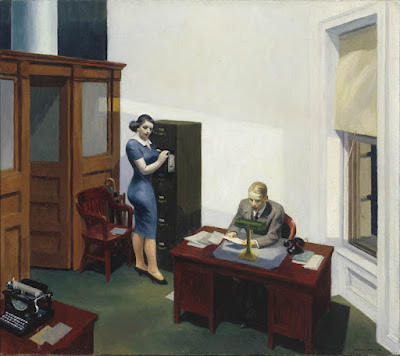


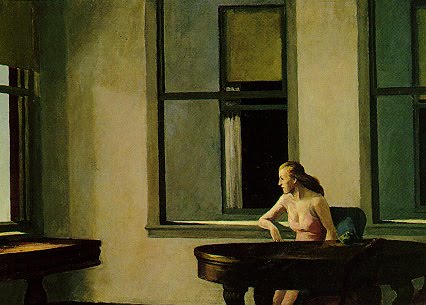

"Edward Hopper loved to ride the elevated train through the city at night. As the apartment buildings raced by in the dark, he would catch flashes of unearned intimacy: lonely people staring at the walls... desperate couples... people whose privacy was protected only by their anonymity.Sometimes I think that artists, like philosophers, are keyhole peepers at heart. They are observers, once-removed from the primacy of experience by the burden of consciousness."David Apatoff
Friday, July 2
Cat by Andy Warhol and... a cat smoking?

 "Don't let Holly know it."
This is the story about Warhol's cat "Sam" at Wikipedia:
Books and print
Beginning in the early 1950s, Warhol produced several unbound portfolios of his work.
The first of several bound self-published books by Warhol was 25 Cats Name Sam and One Blue Pussy, printed in 1954 by Seymour Berlin on Arches brand watermarked paper using his blotted line technique for the lithographs. The original edition was limited to 190 numbered, hand colored copies, using Dr. Martin's ink washes. Most of these were given by Warhol as gifts to clients and friends. Copy #4, inscribed "Jerry" on the front cover and given to Geraldine Stutz, was used for a facsimile printing in 1987 and the original was auctioned in May 2006 for US $35,000 by Doyle New York.[66]
Other self-published books by Warhol include:
- A Gold Book
- Wild Raspberries
- Holy Cats
Wednesday, June 30
Another music? Yes. Bill Wither's Ain't no sunshine

Some songs are interpreted by so many artists that sometimes we forget the author. Maybe not with Ain't no Sunshine, 11 in top 20 songs) in global financial market.
This is the second time Bill Wither is at this blog the first was Grandma's hands that I dedicated to my grandma and the grandmas of the Plaza de Mayo that soon will not be around for too long and will be replaced by members of the families.
Music unites people and even if you don't listen I am sure you know the song and can listen with you memory.
Tuesday, June 29
Luis Buñuel views on religion

"Thank God I'm an atheist."
Luis Buñuel
Right: The Exterminating Angel, 1962, a film by Buñuel
Monday, June 28
August Renoir - Le Moulin de la Galette and Philosophy
 I found this site with the text below and I felt like sharing because it talks about the painting without any kind of theory. I remember one discussion I witnessed between a woman and a philosophy student that made me think a lot. He was very fond of a philosopher and kept repeating that Renoir was not good and gave many reasons. The woman was trying to make him see that he was not "seeing" Renoir because he was blinded by the philosophy he liked and was only fond of artist that could be used as an illustration for this thinker.
I agree with the woman. I have some philosophers I like but I prefer to see the artist without too many theory unless the he or she uses philosophy in their work.
Funny because sometimes it seems to me that painters that depict happiness are out according to some theories and even art-lovers and some critics. Is that a sin or a crime?
"Renoir delighted in `the people's Paris', of which the Moulin de la Galette near the top of Montmartre was a characteristic place of entertainment, and his picture of the Sunday afternoon dance in its acacia-shaded courtyard is one of his happiest compositions. In still-rural Montmartre, the Moulin, called `de la Galette' from the pancake which was its speciality, had a local clientèle, especially of working girls and their young men together with a sprinkling of artists who, as Renoir did, enjoyed the spectacle and also found unprofessional models. The dapple of light is an Impressionist feature but Renoir after his bout of plein-air landscape at Argenteuil seems especially to have welcomed the opportunity to make human beings, and especially women, the main components of picture. As Manet had done in La Musique aux Tuileries he introduced a number of portraits.
The girl in the striped dress in the middle foreground (as charming of any of Watteau's court ladies) was said to be Estelle, the sister of Renoir's model, Jeanne. Another of Renoir's models, Margot, is seen to the left dancing with the Cuban painter, Cardenas. At the foreground table at the right are the artist's friends, Frank Lamy, Norbert Goeneutte and Georges Rivière who in the short-lived publication L'Impressionniste extolled the Moulin de la Galette as
a page of history, a precious monument of Parisian life depicted with rigorous exactness. Nobody before him had thought of capturing some aspect of daily life in a canvas of such large dimensions.Renoir painted two other versions of the subject, a small sketch now in the Ordrupgard Museum, near Copenhagen and a painting smaller than the Louvre version in the John Hay Whitney collection. It is a matter of some doubt whether the latter or the Louvre version was painted on the spot. Rivière refers to a large canvas being transported to the scene though it would seem obvious that so complete a work as the picture in the Louvre would in any case have been finished in the studio."
Sunday, June 27
10 most famous paintings


Saturday, June 26

Friday, June 25
Last century legacy: Piero Manzoni


In March, 2009 the Gagosian gallery did a a retrospective of the Italian artist Piero Manzoni and the site Whitehot Magazine did an article about it written by Marco Antonino:
As new materials started being used the titles usually describe them: Left: Achrome, 1958-1959, Creased canvas and Kaolin 31 1/2 x 39 3/8 inches (80 x 100 cm), Courtesy Gagosian Gallery, NY Right: Achrome, 1961-1962, Artificial fiber 24 3/16 x 18 1/8 inches (61.5 x 46 cm), Courtesy Gagosian Gallery, NY Last century was very rich and is already part of the tradition of the art done today. Some movements and artists still shock and are not fully understood by many but with time things will be more clear. When compared with the art made along this century many things will be watched and appreciated in a different way."Still a relatively overlooked figure, Manzoni (especially in his later work) was pivotal for the development of Conceptualism. Initially inspired by Arte Informale and quickly developing Klein’s (as well as Duchamp’s) radical and irreverent transgressions in the direction of a greater interest for – and ability to imaginatively build upon – reality, Manzoni’s art defies easy categorizations and conventional labels.His first Achromes monochrome series, dating back to 1958 and extensively represented in the Gagosian exhibition, are still indebted to Arte Informale and in particular to Burri’s emotional surfaces in their attention to the plastic values of the support. The clay, caolin and gesso used on the immaculate canvases are stretched and allowed to form expressive wrinkles and cracks. Given the hyper-consistency of the series and the sheer quantity of canvases amassed in a single room I felt a little overwhelmed by the barricade of white, chalky canvases... but hey, we’re still at Gagosian, right?"
Thursday, June 24
Ingenuity, freedom and dogs
 I found it at my "documents" while searching for two pictures to post and felt like sharing. It makes sense to me and this statement is like a reminder for some occasions when I don't know exactly what to do.
Wednesday, June 23
Young man reading by candlelight by Mathias Stohom

Young man reading by candlelight, 1600-1650, by Mathias Stohom
Just look...
Subscribe to:
Posts (Atom)